The morning had barely started when N.R. Narayana Murthy walked in. He was running his eightieth year, as he would say—still travelling, still showing up wherever something extraordinary was happening. And NIE, the National Institute of Engineering in Mysore, was where he had studied electrical engineering more than half a century ago. He wasn't there to lecture. He was there to listen.
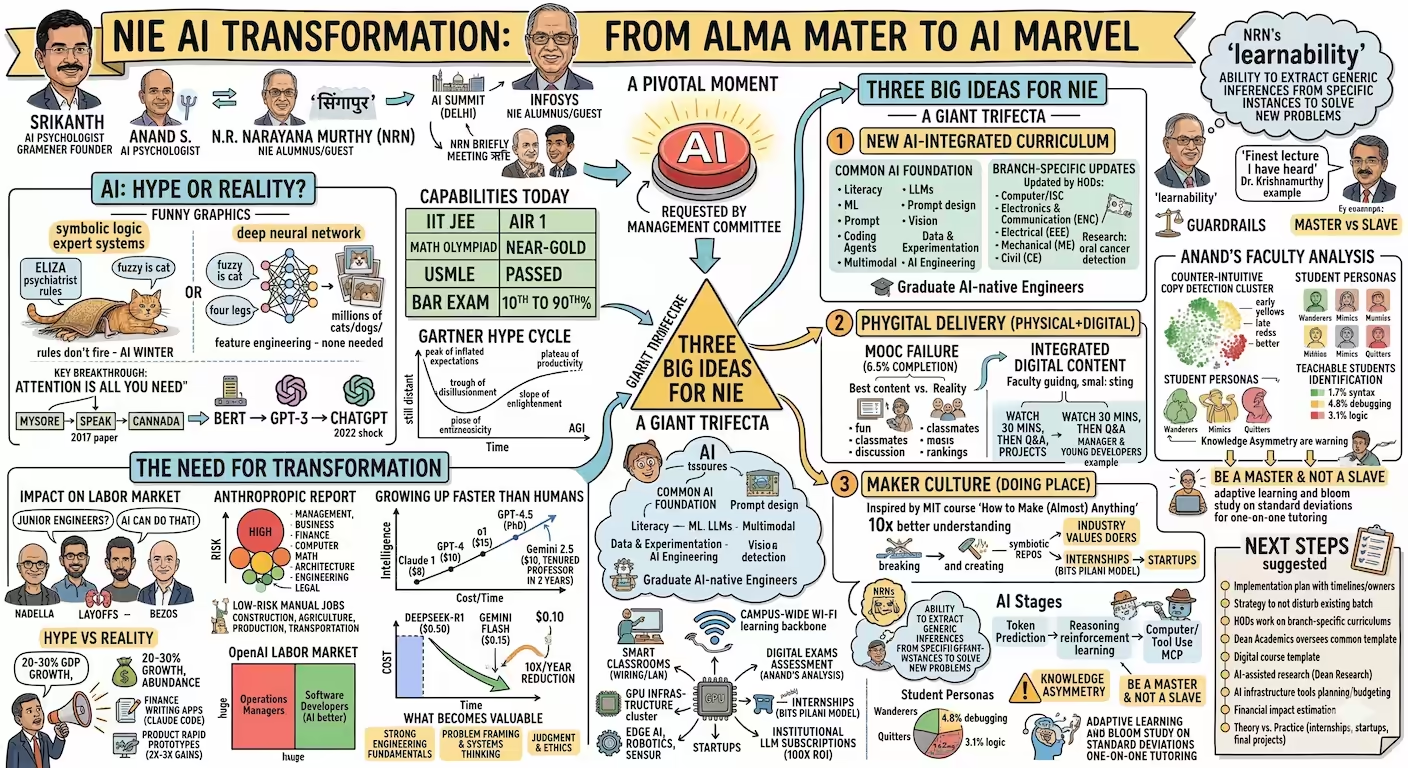
On a laptop screen in Singapore, Anand S., LLM Psychologist at Straive, was adjusting his audio settings. In the same room, Srikanth Nadhamuni—NIE alumnus, co-founder of Trustt, the architect behind India's Aadhaar and UPI stack—was gathering faculty members and department heads for a very different kind of faculty meeting. The agenda: how to transform an engineering college for an age when AI had already passed the bar exam, topped the IIT Joint Entrance Examination, and was closing in on a gold medal at the International Math Olympiad.
Murthy had just returned from the AI Summit in Delhi, where he'd briefly met Rishi Sunak. He'd politely declined to speak at the Summit—"too many people," he said, "zillions of fellows"—but he had come to NIE. That contrast alone tells you something.
💬 Read the full transcript →
The Question in the Room
Before Srikanth said a word about curriculum, someone in the management committee had already asked it. The question that every engineering dean in the world is quietly sitting with right now, too cautious to ask too loudly: Is AI hype? Or is this real?
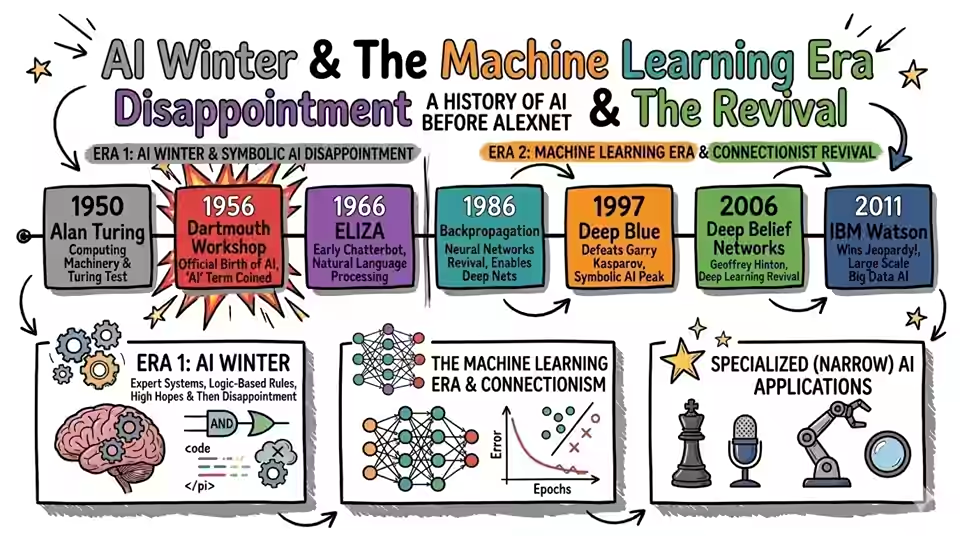
Srikanth answered it the way engineers answer things: with data. He walked the room through seventy years of AI history in about ten minutes—from Alan Turing's 1950 Imitation Game, through the symbolic rule-based systems of the 1960s (ELIZA, the psychiatrist chatbot, was famous at MIT when he went to college in the US), through the AI winters that followed, to the neural network renaissance and the single paper that changed everything.
Slide · Seven decades of AI, from Turing to Transformers
"In the earlier approach, we would literally code rules and say: cat is furry, it has four legs, it has whiskers. If a cat is under a carpet and only the tail is sticking out, you can't find out all this because those rules don't fire. Whereas human beings—even if you see a tail coming out of a carpet, you know this is a cat."
— Srikanth Nadhamuni
The breakthrough came in 2017, with a paper called . Written by eight researchers at Google—led by Indian engineer Ashish Vaswani—it proposed a deceptively simple idea: when predicting the next word in a sentence, you don't need to remember everything. You just need to pay attention to the right things.
Slide · The Transformer: one paper to change everything
Five years after that paper, ChatGPT arrived. Within months, the world's most intimidating professional exams started falling. The US bar exam: GPT-4 scored in the 90th percentile. The USMLE: passed. The International Mathematics Olympiad: four out of six questions correct, approaching gold-medal level. The IIT Joint Entrance Exam—considered by many the hardest undergraduate entrance examination in the world—AI is now scoring at the All India Rank 1 level.
"Not only is it smart, it is getting smarter very, very fast. In many areas, it's doing better than human beings."
— Srikanth Nadhamuni
The Price of Intelligence
Then Anand took over the screen. What he showed next is one of those things that sounds like a statistic until you feel the weight of it.
In March 2023, the most capable AI model available—Claude 1—cost roughly $8 to process the equivalent of all the Harry Potter books. It was performing at about an 8th-grade level. Eighteen months later, with the release of DeepSeek-R1, that same level of processing cost fifty cents. With Gemini 2.5 Flash, it fell to fifteen cents. Today: ten cents.
Pause on that for a moment. In two years, AI went from the level of a middle-schooler to a tenured professor. And it got 150 times cheaper along the way. As Anand put it:
"In two years, it has covered what humans would have taken 10, 12 years to cover. In other words, Artificial Intelligence is growing up faster than humans are growing up in their intelligence. Any human."
— Anand S.
Then he made it personal. Imagine you needed an MBA-level analyst two years ago. You would have paid fifteen thousand dollars to get a million tokens worth of analysis—roughly the equivalent of a thousand books. Today? One hundred and fifty dollars. Same intelligence. A hundred times cheaper. And when Anand said, "For the same budget, I will hire a hundred of you," the room went quiet.
The Economics Are Changing Dramatically
Cost per million tokens for state-of-the-art models: $15 → $0.10 between Sep 2024 and mid-2025. That's 150× cheaper in under a year. Meanwhile, capability improved from Masters to Tenured Professor level. The cost is now falling roughly 10× per year.
Source: LLM Pricing Explorer (built by Anand S. with vibe coding)
Not Just Code: The Jobs Map
But Srikanth wasn't just talking about price. He was talking about the institution's survival. Engineering colleges exist to produce engineers who get jobs. And an Anthropic research report, published just two days before the talk, was drawing a map of disruption that pointed directly at STEM.
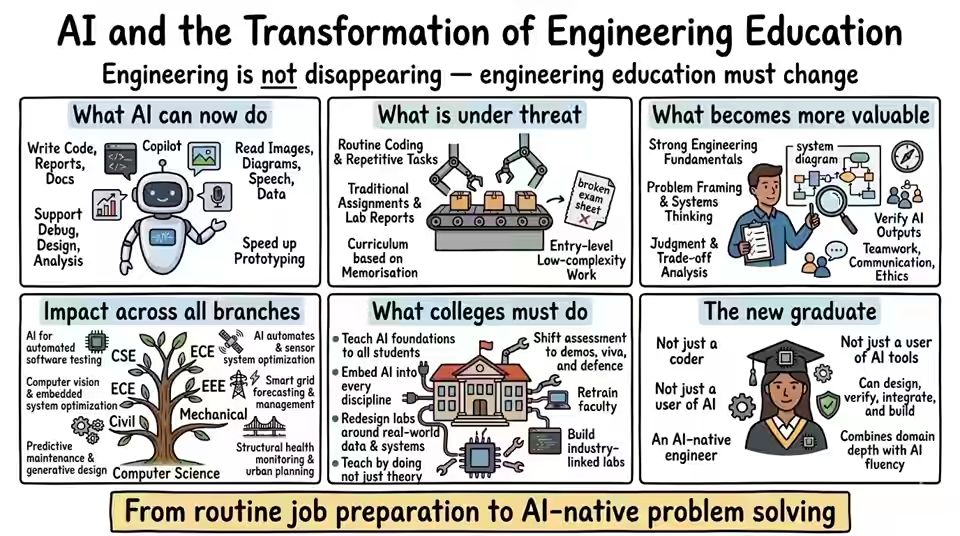
Slide · Jobs most at risk — Anthropic's analysis, March 2026
Management. Business and finance. Computer science. Architecture. Engineering. These weren't the jobs AI was approaching—they were the jobs AI was already better at in significant sub-domains. Anand showed a treemap of American professions, sized by total annual salary, colored by whether AI or humans were currently winning. Software development: AI winning. Financial advice: AI winning. Meanwhile, construction, agriculture, and transportation: largely untouched.
"Should I hire an AI? Should I hire a human? For personal financial advice, AI is better. So my next investment—I went straight to ChatGPT, asked it for my risk preferences, and it told me which index fund would probably have the best performance."
— Anand S.
What Anand was describing wasn't hypothetical disruption. It was his own behavior, right now, today. He wasn't asking whether the future would change jobs. He was showing that it already had—for him. And if it had changed for him, it had changed for everyone in that room's students too, whether they knew it yet or not.
The Gray Students
Here is the moment in the talk where something genuinely surprising happened. Anand had been building AI tools for his IIT Madras course on data science—a course where he had one unusual policy: copying was allowed. Not just tolerated. Explicitly allowed.
When you allow copying, you get data. And Anand had AI analyze that data to map exactly who was copying from whom, when, and how deeply. He found clusters—a group of 32 students all sharing the same code, with one original creator in green, the first copier in yellow, and waves of secondary copiers spreading out like a social network graph.
Slide · Who copied from whom — AI maps the student collaboration network
Then he looked at scores. The originals—greens—scored highest. Makes sense. The late copiers—reds—scored higher than the early copiers—yellows. Puzzling at first, until you realize the late copiers had more submissions to choose from, and had time to filter for better ones. "Even in copying, there is strategy and you have to apply your brains for it," Anand said, with a smile.
But the real shock was the grays. The students who neither copied nor allowed anyone else to copy from them. Students who went it alone, with fierce independence, refusing all collaboration. Srikanth had assumed these must be the brightest students—the disciplined self-starters.
They scored the lowest of any group. Statistically significant. Decisively.
"I always thought those really serious ones who'd say, 'I will do it myself'—I really thought those are probably the brightest ones. It turns out the ones that collaborate end up actually doing better. This was completely counter-intuitive to what I thought."
— Srikanth Nadhamuni
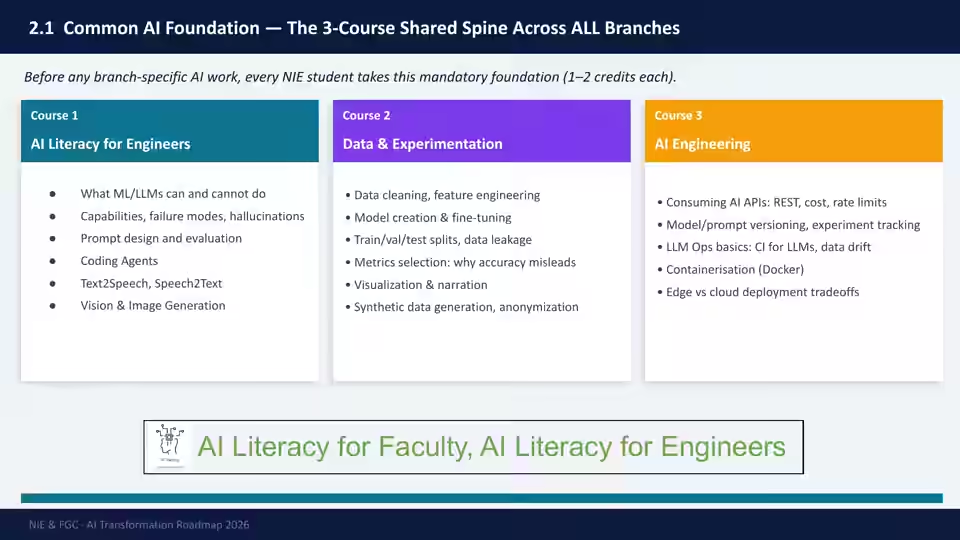
But Anand didn't stop there. He also had AI analyze the behavior of students while they were writing code—keystrokes captured every few seconds, revealing seven distinct student personas. The Wanderer, who builds a partial mental rule and gets stuck in loops. The Mimic, who hard-codes solutions to exactly the problem asked, failing any generalization. The Ghost, who disappears. Each one, mapped with enough granularity that a teaching assistant could pull a specific student into a fifteen-minute session and know exactly what concept they needed.
"Give me just the 10% teachable students. See, there are a bunch of students who are doing great. There are a bunch who are very hard to teach. I want to intervene in the best possible way."
— Anand S.
The AI found them. Syntax learners: 1.7%, here are their IDs. Debugging trouble: 4.8%, put them in one session. Logic strugglers: 3.1%, here's what to teach them.
"That to me," said Anand, "is transformation of education."
Forty Slides in Forty Minutes
Then Anand did something that few teachers do in front of a room full of faculty: he opened ChatGPT and dictated a prompt on the fly.
He wanted to teach logistics using the US-Iran war as a real-world backdrop. He'd never prepared this. He literally composed the prompt while speaking—asking for an interactive four-slide HTML presentation, with SVG animations, Kannada-English toggle, and thought-provoking questions for classroom discussion. He pasted it into Gemini and came back four minutes later.
The result: four slides about choke-point vulnerability, the Theory of Constraints as illustrated by ships rerouted around the Cape of Good Hope, cost of just-in-time failure—all derived from a war happening right now. The AI had even picked Tamil instead of Kannada (Anand's own usage history leaking through), which got a laugh.
"Four slides in what, four minutes or less. 40 slides will take 40 minutes at the worst case. The bottleneck is just our imagination."
— Anand S.
He also showed what a college intern named Varun had done with an NCERT Class 12 History textbook: fed it to an AI page by page and asked it to find factual errors. Out of 45 claims reviewed, it found one factual error—the textbook's assertion that "only broken or useless objects would have been thrown away," which turns out to be significantly wrong. Bronze Age societies regularly deposited intact objects for ritual purposes, migration, and recycling. Varun had found a real error, in an official Indian textbook, without even being an expert historian.
Student Project
NCERT Textbook Error Analysis
Varun's AI-powered analysis of factual claims in India's official history textbook
Research at 100× Speed
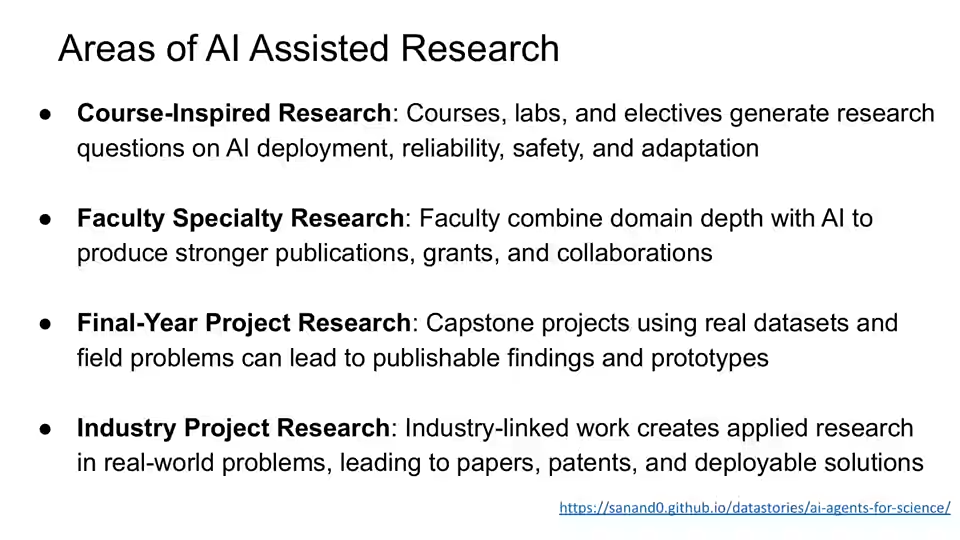
NIE's NIRF ranking was a quiet sore point in the room. The college was stuck in the 150–200 range. Srikanth said it plainly: "We are barely hitting one paper per faculty per year. I have seen productivity levels in companies of 100, 200, 300% improvement, and I can't see why engineering colleges cannot do the same."
Anand showed them how. He opened his "Ideator" tool—a personal note-taking app that randomly combines two of his ideas and asks AI to generate a research proposal. While Srikanth was talking, he had combined two random concepts: the Magnus Effect (how a spinning cricket ball curves through air) and the practice of prayer.
The AI's proposal: maybe prayer works like spin does on a cricket ball. Not through metaphysics, but through a physical mechanism—repetitive rhythmic breathing creates asymmetric pressure in the body's autonomic nervous system. The Catholic rosary is six breaths per minute. The Sufi dhikr: twelve cycles per minute. Nobody had ever mapped prayer frequencies across traditions to see if they cluster at the body's physiological resonance peak. That's a paper nobody has written. Five minutes of AI work identified it.
"This happened in about five minutes with me not even doing any work in this area. Now I'll give it to a bunch of PhD students and say: do your research. Like this I have 50 ideas, and I'll happily co-author. I have 50 papers."
— Anand S.
The room laughed. But they also wrote it down.
The Man Who Defined Learnability
When Srikanth finished, he turned to the man in the audience who had been quiet for two hours. "Sir, you have enormous experience. What are your thoughts?"
Narayana Murthy took a breath. Then he said what no one in that room expected.
"Srikanth and Anand, this is one of the finest lectures I have ever heard on any platform. And much more so, the finest lecture I have heard in almost 60 years at NIE."
— N.R. Narayana Murthy
The last lecture to earn that comparison? A professor named Dr. N. Krishnamurthy, who had walked a class of engineering students through three methods of structural analysis—slope deflection, moment distribution, column analogy—with such clarity that even electrical engineering students like Murthy came to listen. Something about that talk had never left him.
Now, fifty-eight years later, he was reaching for a word he had coined in 1975, when he was designing the training program at Infosys.
"Learnability is the ability to extract generic inferences from specific instances, and use them in a structured manner to solve new problems."
— N.R. Narayana Murthy, 1975. The foundation of Infosys's training program.
That was the word. Not AI literacy. Not coding. Not prompt engineering. Learnability. The meta-skill that lets you take anything you've been taught and apply it to a problem you've never seen before. It's what good engineers have always had. And it's the one thing, Murthy argued, that AI cannot replicate from the outside—it has to be developed from within.
He wanted something more from the talk than a technology roadmap. He wanted NIE to go further: to teach analytical thinking as a subject. Not just how to use AI, but how to confront an unknown problem with whatever structured knowledge you carry. How to look at a rainbow and connect it to the physics of refraction. How to hear a car driving away and understand the Doppler effect without being told to notice it. These were the intellectual habits, he said, that should begin not in engineering college but in primary school—and engineering college might be the last chance to develop them.
"As long as we use these technologies in an assistive manner and we remain the masters, this is a safe world. But that big question of how do I relate what I know today to make an attempt at solving an unknown problem—that to me is the huge challenge."
— N.R. Narayana Murthy
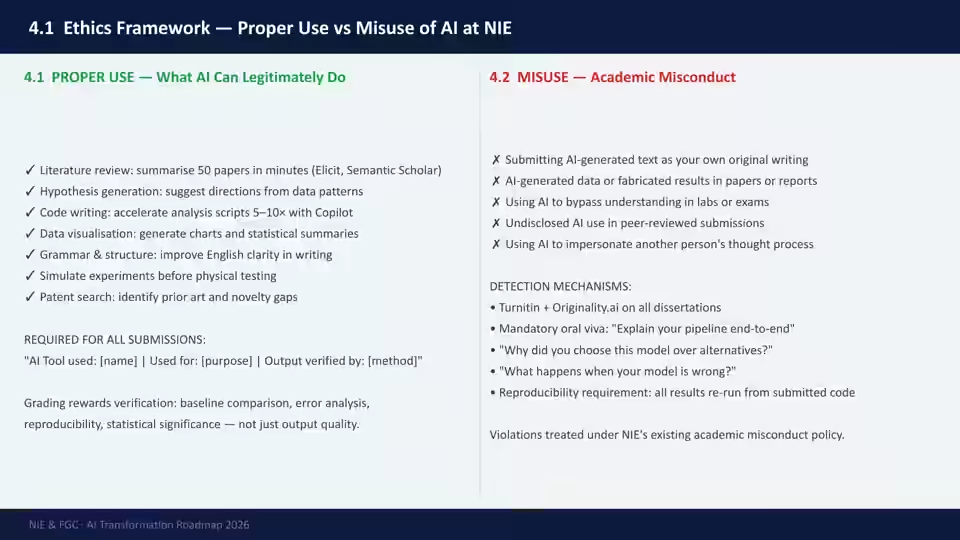
A faculty member named Ramnath pushed back gently from the audience: students must not become dummies, must not become slaves to AI. Srikanth nodded. Yes. The line between a student who uses AI to solve harder problems and a student who uses AI to avoid thinking is real, thin, and consequential. The educators in the room would have to figure out where it is, without a map, while moving fast.
Anand offered a different frame. He had surveyed his own students and found that nearly half weren't copying even when explicitly allowed. The independent students weren't the problem. The bigger problem, he said, might be something else entirely:
"More often, I'd say 95% of the people are underusing AI. Maybe the bigger risk is underuse."
— Anand S.
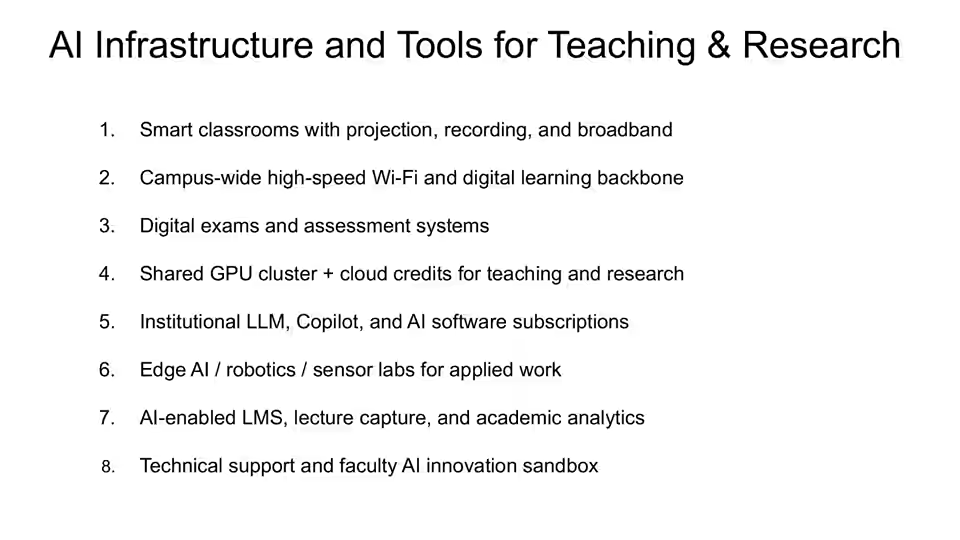
And Srikanth added one more worry—the one that had driven him to join the government's AI Centers of Excellence committee in the first place. The divide between students who have AI and students who don't is not a gap. It is a chasm. India had bridged that chasm before, with Aadhaar and UPI—making the most sophisticated digital infrastructure work for a banana vendor using a feature phone. The same playbook needed to run for AI. The alternative was a knowledge asymmetry so deep that the institutions meant to produce the next generation of engineers would themselves become obsolete.