The whole session, one page
Drawn afterward from the transcript · click to zoom
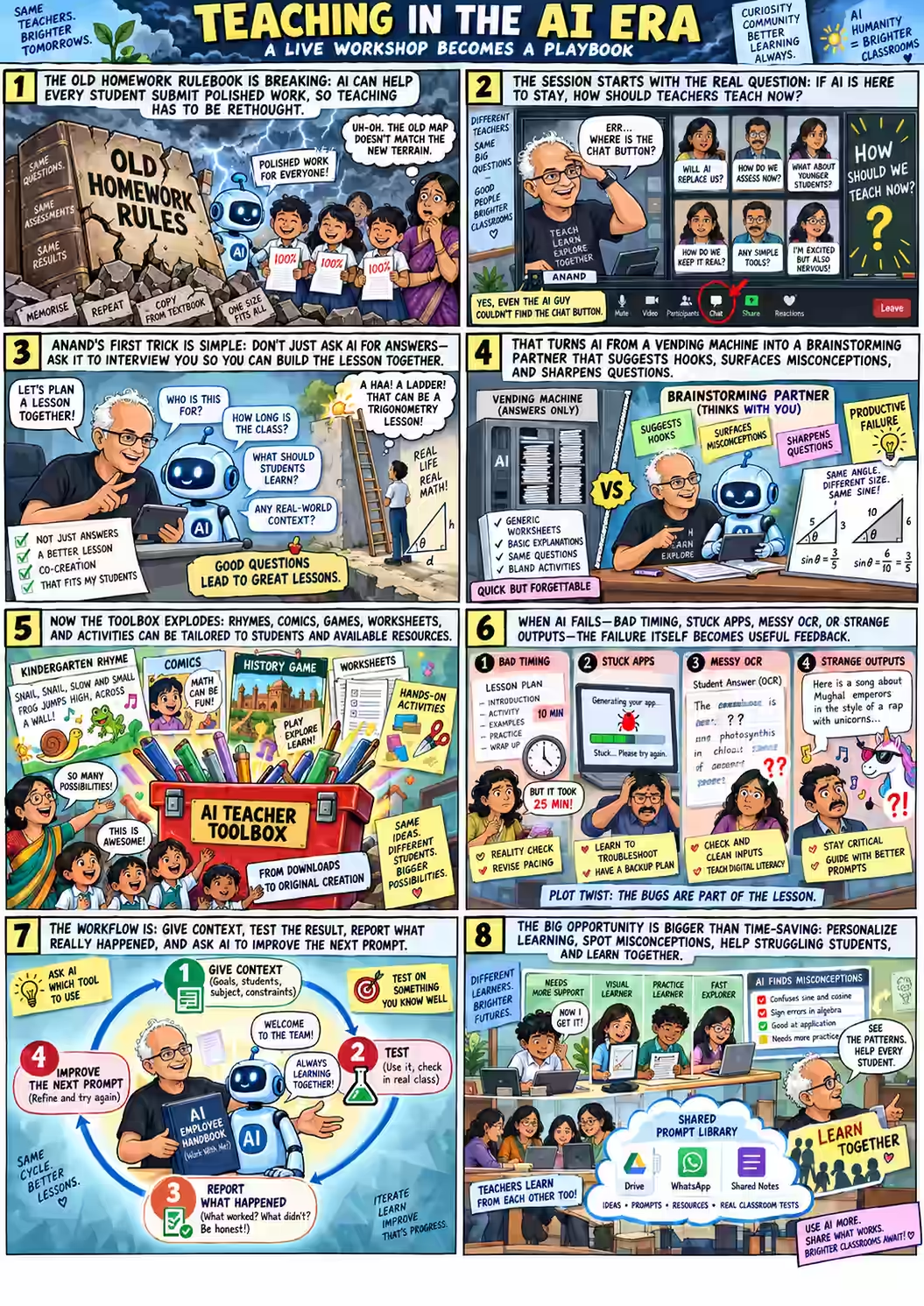
Anand opened by fumbling the Zoom toolbar in front of fifty teachers — then turned the fumble into the first lesson. Two hours later, the room had rewritten how they ask AI for a lesson plan, a rhyme, a fact-check and a second chance.
Drawn afterward from the transcript · click to zoom
Before anyone said hello, before the introductions, Anant Mani opened the call with a diagnosis, not a welcome.
"It's kind of a disaster, right? Because the whole curriculum pedagogy for higher education and in post-graduation, everything has to be re-thought because everyone is submitting a fantastic homework, every test is 100% marks, because none of them is written by the students. It's crazy."
Anant Mani, opening the call
Then the irony arrived within the first six minutes, and nobody in the room let it go.
Anant had just finished introducing his old IIM Bangalore classmate as a man who needed no introduction — an IIT Madras alumnus who, at IIM Bangalore, was the rare student to top both the academic and extracurricular rankings in the same year, and who currently teaches Data Science to three thousand students a year without ever meeting one of them in person. Anand thanked him, said hello to the room, and then asked the only question that mattered right then:
"This makes it very awkward and embarrassing for me to ask the next question because I'm supposed to be an IT expert and all kinds of things. But how do I find the chat in Zoom? Can anyone help me please?"
Anand, six minutes into a talk about AI
Harish Srinivasan, hosting for Infinite Engineers — the outfit that had spent years since 2013 setting up Atal Tinkering Labs in 250+ schools, including Shree Niketan's — went hunting through the settings. Anant, on his own machine, hit the same wall. And Anand did the thing he was about to spend two hours telling teachers to do: he stopped trying to solve it himself.
"Tech is beyond us, right? I mean, this is the kind of thing I'm very tempted to just take a picture and share it with Gemini or ChatGPT and ask, 'Look, where am I supposed to find the chat button?' Actually, I'm going to do that." He screenshotted his own Zoom window and asked ChatGPT to look at it.
Anand: "I'm on Zoom, as you can see from the screen, but I can't find the chat button. Is it disabled or what do I do?" [attaches screenshot]
ChatGPT: "It's most likely hidden, not disabled. Click the three dots 'More' near the bottom... If Chat is not in that menu, then the host has probably disabled in-meeting chat for participants."
Two more screenshots later, ChatGPT changed its mind: "Chat is not merely hidden. It is disabled for this meeting/account." — and pointed at the Zoom web portal setting an admin would need to flip.
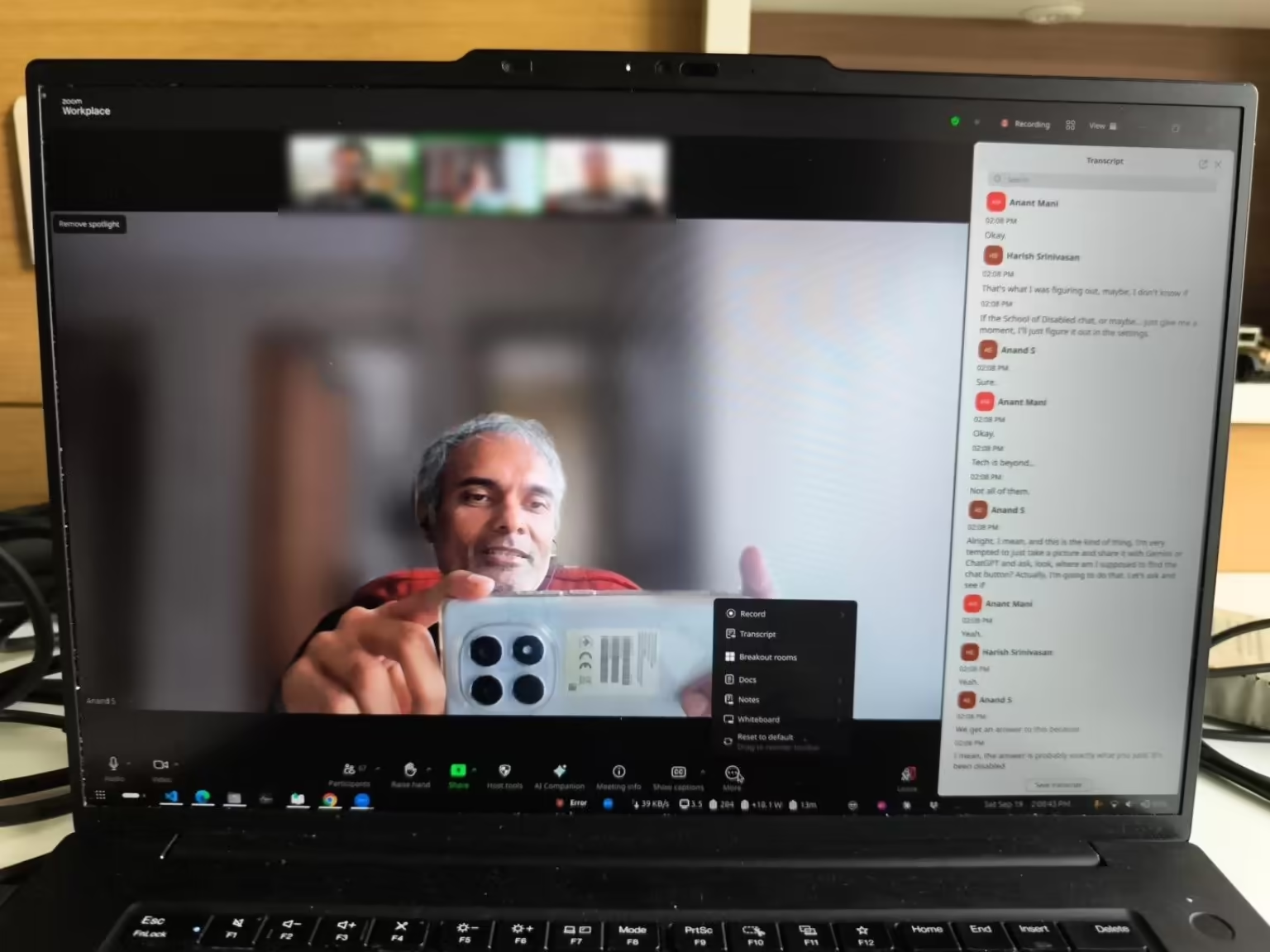
The actual screenshots Anand fed to ChatGPT, mid-call — photos of his own laptop, phone in hand, live transcript running on the right. Two more: the More menu · the captions menu.
The diagnosis was correct — the school's Zoom account had disabled chat at the organisation level, a setting no one in the meeting could override. Nobody had needed to know that fact five minutes earlier. Now fifty teachers had watched the most AI-fluent person in the room out-source a small, humiliating problem to the tool in about the same time it would have taken to ask Harish twice more and wait.
That was the whole talk in miniature, and Anand knew it. Everything that followed was a longer, more deliberate version of the same move: stop treating AI as a vending machine that dispenses answers, and start treating it as someone you talk things through with.
A teacher — call her Teacher C, from Shree Niketan Global — had opened the floor with the question every staff room eventually asks out loud: if AI can write the lesson plan, are we losing our own creativity as teachers? A fourth-standard child had already told her, unprompted, "Ma'am, don't go into ChatGPT, open Claude."
Anand's answer started with history rather than reassurance. Half a generation ago the same fear attached to Google and Wikipedia — if all knowledge is searchable, why memorise anything? The verdict then, he argued, generalises now:
"90% of the things that we used to learn and memorize became smaller... I don't — beyond maybe two or three phone numbers, I don't remember any phone number. Have I lost something essential? Definitely. But that emergency happens maybe only 1% of the time, so we find that loss acceptable because 95% to 99% of the time, the benefit is there."
Anand
Then, instead of continuing to argue, he opened ChatGPT's voice mode on his phone and built a lesson plan live, on the call, narrating his own reasoning as he went.
Anand: "I don't want you to create a lesson plan for introduction to trigonometry. I want you to interview me. Ask me questions that will help us together come up with the lesson plan."
ChatGPT: "Sounds like a plan. First, who is this for? What do they already know?"
Grade 7, a little algebra, half an hour, part of a longer unit, general introduction. Then ChatGPT asked one more question — "How comfortable are you with using visuals or physical demos? Even something like drawing a triangle or using a ladder against the wall?"
"A ladder against the wall is a very nice way of introducing trigonometry. I would not have thought of that. Now, at this point I start wondering: who is bringing in the creativity? ... 'Interview me' is one of those magic words. It changes the relationship from 'I tell you, you do' to 'let us collaborate' — enhancing it beyond my creativity, beyond its creativity, into something combined."
Anand
He kept pushing the same conversation in stranger directions live on the call, and each turn taught the room a reusable move rather than a one-off answer.
Turn one: ask it to find the top misconception, then write a question that walks students straight into it. ChatGPT identified the classic error — students think sine and cosine change with the size of a triangle, not just its angle — and built a two-triangle comparison question designed to surface exactly that confusion before correcting it.
Turn two: stop asking for content and start asking for pedagogy. "Misconceptions are one way of teaching. Are there other ways?" ChatGPT's answer was Productive Failure with Contrasting Cases: give students an unsolvable problem — comparing the steepness of two differently-sized ramps — let them flail with wrong ideas, then show them a set of triangles where every idea breaks except the one ratio that stays constant. "That moment — 'Oh, the ratio doesn't change when you scale!' — becomes the hook. Then you name it: that's Tangent. They've basically invented a piece of trigonometry."
Anand's gloss on the exchange doubled as an answer to Teacher C's original worry: "So very good point. Why should we spoon-feed them? Toss them a problem which we know they cannot solve — that is the whole point of what we are going to teach." The creativity hadn't been out-sourced. It had moved — from writing content to designing the collision between a student and their own wrong assumption.
Teacher E, who handles the KG department at Shree Niketan Matriculation, spoke next — and her use case was already further along than most of the room realised. "We are creating our own stories, rhymes, even worksheets... nowadays we are creating new rhymes, sir." Her music teachers took AI-written lyrics and set them to their own tunes.
Anand opened Gemini on his phone, tapped the little plus button, found the option most people scroll past — Music — and asked for exactly the kind of rhyme Teacher E's classroom needed.
Anand: "Can you create a nursery rhyme about numbers? Keep in mind that the lyrics should be the focus, I don't want the music to drown out everything. And keep it short — this is for a kindergarten audience. Make the rhythm nice and memorable."
Gemini wrote and sang it back in one pass — a full verse-chorus-verse-chorus counting rhyme, one creature per number, ready to perform.
The model behind the song is Lyria, folded into Gemini for close to a year by the time of this call. "One snail crawls right here, two big birds appear, three green frogs they jump, four worms on a bump..." — one creature per number, all the way to ten small ants, a chorus that repeats on purpose so a room of five-year-olds can join in by the second pass.
Anand's real point wasn't the novelty of a singing chatbot. It was what the song frees a teacher to do next. "Having the model create a song means now the students are free to perhaps perform to it. Can one student be the snail? Can one be the frog?" He's used the same trick to close out workshops for IAS officers — a Gemini-composed vote of thanks naming everyone in the room — and to fill dead air before Zoom calls start, with a song built entirely around that session's theme.
From there the toolbox kept opening. A generated video, timed so the snail visibly enters exactly when the lyric says "snail comes in," raises the stakes again — useful, Anand suggested, for children who have never actually seen a frog and for whom a static cartoon frog doesn't quite land the same way a moving one does. And the tool he personally reaches for most for younger children — comics, one panel at a time, turning even a complex concept into something a six-year-old can read at a glance.
Teacher E's own workflow had already absorbed all of this: her school gets a daily plan built on AI, projected on the smart board, story-rhyme-activity, "which was very engaging as well as they were happy nowadays." Anand's response reframed her small efficiency win as something bigger — a template for how any grade could use AI not just to save teacher time but to teach students to think alongside a tool rather than merely query it: ask a student to teach AI something, or argue a position against it, and read what they typed rather than only what they got back. That thread — homework as a transcript of thinking, not just an output — resurfaces later in the session, once the room starts asking about grading and plagiarism.
Teacher E's line about "using the resources we have" nudged Anand toward a demonstration he'd clearly done before and enjoyed doing again: pointing AI at an official NCERT textbook and asking it to check its own homework.
A colleague had already run this on a Class 12 history textbook using Claude, working through it page by page. Most flags were minor. One wasn't. The textbook claimed that only broken or useless objects would have been thrown away in antiquity — a tidy assumption that turns out to be wrong. Archaeology repeatedly finds intact, fully-functional objects deliberately discarded: ritual offerings left before a deity, or possessions abandoned when a community had to move on. A second flag was softer but telling — a claim that Mauryan forces under Chandragupta numbered "600,000 foot soldiers, 30,000 cavalry and 9,000 elephants," sourced to "Greek sources" that the model could not actually locate: "might have been true, but if so we don't know where it came from."
The tool behind that kind of pass is public: Textbook Analysis and Fact Checking, built by Varun Agnihotri, methodically checking textbook claims against scholarly sources — in one run, 56 pages analysed, 45 claims verified, a small handful of factual errors, precision issues and questionable claims surfaced for a teacher to judge.
pythonicvarun.github.io/textbook-analysis — the same method Anand described applies well beyond history: "auditing open-source codebases, analyzing research papers," anywhere a document makes claims that can be checked against sources.
Then Anand turned the demonstration around. Rather than only checking a textbook for errors, could the textbook become the raw material for something students would actually want to open at home? Live, on-screen, he pulled up the NCERT Class 8 History textbook, picked Chapter 3, "Ruling the Countryside" — the Diwani grant, the Permanent and Ryotwari settlements, indigo and the Blue Rebellion — more or less at random, and gave ChatGPT one instruction:
"Create an engaging game for the students of class 8 that will be based on the lesson in this particular chapter that I have uploaded. Think of a nice game that will teach the concept in this chapter... Then publish it."
The chapter itself — the direct PDF of Chapter 3, "Ruling the Countryside" — opens with Robert Clive accepting the Diwani in 1765, the same grant the game below turns into a playable decision. (NCERT's server blocks embedding, so it's a direct link rather than a preview here.)
He kept talking to the room for the fifteen-to-twenty minutes it took to build, then came back to a published site: The Indigo Ledger — an eight-case, phone-friendly simulation where students play the East India Company managing grain, coin and "courage" balances across decisions on revenue collection, land settlements and the indigo debt trap, each choice followed by an evidence-based explanation of what actually happened.
"The Mughal Emperor has appointed East India Company as the Diwani of Bengal, Bihar, and Odisha. What can the company do?" Anand picked "collect land revenue" — correct, the game confirmed, the company became the region's chief financial administrator. A later guess went the other way: grain and coin balances both dropped. "Okay, that is bad."
Play it yourself: indigo-ledger-class-8.root-node.chatgpt.site — built in the fifteen minutes described above, published after the session.
Watching himself lose points on a bad ryotwari decision led Anand to the observation that mattered more than the game itself: "Games are not just a means of informative learning. They are extremely powerful tools for identifying learning paths. Very granularly we can identify what decision a student is making, what thinking they have." Ask the same tool to log which choices each student made, and a teacher gets something no worksheet gives them — a map of exactly which misconception belongs to which child. "Shyamala, you and Rohit don't seem to understand how tangents are different from cotangents, so let's talk about that."
His advice to Teacher G, who'd been experimenting with something similar, was blunt about the odds: "'Go home, play this game.' It's one thing to revise the chapter; it's a different way or mode of learning for them to interact... at least one out of three times we find useful to share with students." One in three is a batting average worth publishing more of, not a reason to stop.
Anand had asked twice for failure stories, and it was Teacher G who supplied the best one — not a hypothetical, a live problem she was stuck on right then. She'd had Claude build an interactive HTML revision app from her class notes and worksheets. It worked, mostly. But Claude kept telling her to put it on GitHub to make it usable, and she didn't have a GitHub account, didn't know how to get one, and had hit a wall.
"Excellent example of a solvable failure, Teacher G ma'am... What I usually tell participants in my workshops is: tell Claude to create the GitHub account. Tell Claude to push it somewhere. Or you can say, 'No, I won't give you a GitHub account, where else can you submit it?' You will find that it will do it."
Anand
Teacher G had already, on her own, found a different route — Bolt.new, a free account, half the app rebuilt there overnight. Anand's response wasn't to correct her workaround but to name it as the actual method: "Very good. Tomorrow if something else comes up, we'll switch to it... the cost of creation is so low." His suggested next step, if an AI tool claims it can't do something — "get me a free account, ask me any questions if you need" — followed by, if it still balks: "is there some other tool that can do it?" AI assistants, it turns out, know about the Claude browser extension that lets them act on a real browser when they claim they can't.
Anant, unable to resist handing over the answer Anand was deliberately withholding, jumped in with the free-hosting options anyway — Vercel, GitHub Pages, and Cloudflare Pages — while acknowledging the pedagogy: "that's not the idea what Anand is saying... he's teaching you how to fish instead of giving the answer." Another teacher, unprompted, mentioned watching ChatGPT's Codex agent independently locate and finish an entire Mario game from a single prompt — evidence, to her, that "we are in the AI era" in a way that made Teacher G's stuck HTML file feel almost quaint.
Two failure modes surfaced that had nothing to do with technical skill. Teacher J asked the practical question hanging over every CBSE grading conversation: how reliable is AI at reading messy handwriting, and is it even safe to upload a student's answer script to a model at all?
Anand's answer to the accuracy half was a distribution, not a verdict: "Some models are worse than the worst humans; many models today are in the human range; there are a few models that are better than the best humans even now. And the models are constantly improving." Where today's model isn't good enough yet, he offered three concrete fixes rather than a wait-and-see.
The privacy half of the question got a more careful answer, one Anand returned to at length later in the session — see Whom do you trust below.
The other failure was harder to engineer away. Teacher E, back for a second question, described a specific, recurring gap: an AI-generated kindergarten activity manual would confidently allocate "10 minutes" to an activity that, with real five-year-olds in the room, simply couldn't be done in ten minutes. "AI cannot connect with the physical things with us, right? How we can handling the kids."
Anand generalised this immediately, because he'd hit the identical wall himself — with meeting prep that assumed a conversation would go where he'd planned it to, and with emails whose content was right but whose tone was wrong for the specific friend he was writing to. His fix became the hinge for the rest of the session.
The fix is almost embarrassingly simple to describe and, Anand admitted, still rare in practice: tell the model what actually happened, even when it doesn't ask.
"Whenever anything that I ask AI does not happen, or even when it happens, I add one more chat at the end saying, 'This is what happened.' ... 'Just for your information, this is what happened: I was planning for a 40-minute session, but I was only able to cover the first 25 minutes... Just FYI, no response required.' And I send that chat, and it doesn't respond also."
Anand
Do that for ten sessions and a pattern shows up that no single session reveals. In Anand's own case, the model told him something he half-suspected but hadn't proven: he covers a full lesson plan reliably when there's no discussion, and reliably runs over whenever students engage — so the model suggested splitting every future lesson plan into a core set of must-cover topics and an optional set to drop under time pressure, plus a short list of phrases to redirect a conversation that's drifted.
He runs the same audit on himself, weekly, using his own recorded talks — including, he mentioned mid-session, this one. "I pass it to my models and say, 'This is what I'm doing. Use this input, give me feedback. Did I make any factual mistakes?' The sheer number of factual mistakes that I make is very humbling." Two categories came back reliably: he over-states magnitudes (model release dates, mostly), and he answers the factual question a person asked while missing that they wanted comfort, not information. "Chalo, one more thing to add to the list."
"AI is able to use real-world information so effectively that one of the most important things a human can do these days is make sure that we have the information that we can give it."
Anand
Teacher I, who uses AI for academic planning and performance analysis, pushed on exactly this point: "AI gives us a starting point, but we cannot use the output directly because sometimes I could see the mistakes... So how can we prompt AI effectively to avoid these mistakes and to get more reliable results? Is there any standard prompt or the framework you would recommend for the teachers to get the consistency?"
Anand's answer was that mistakes will only get rarer, never disappear — because the questions worth asking keep becoming more subjective, to the point where even human experts disagree with each other 5% of the time on well-defined categorisation tasks. So the next step, he argued, is the one almost nobody takes: after collecting a week's worth of disagreements and getting the model to draft an improved prompt from them, benchmark whether the new prompt is actually better, rather than assuming a plausible-sounding fix works.
He walked through a real example of a prompt that looked obviously good and tested badly. Someone on Twitter/X had recommended appending a fixed instruction to every chat:
"Only report to me in ASD-STE100 Simplified Technical English."
ASD-STE100 is the aerospace industry's controlled-vocabulary standard for maintenance manuals — short sentences, one idea per sentence, no jargon. It reads like exactly the fix a teacher would want for a student who "writes too complex." So Anand tested it, on a set of the questions he actually asks day to day, with and without the suffix, and asked a model to judge the answers on correctness, on whether they captured the key drivers and mechanisms, on caveats, on calibration, on actionability.
| Prompt variant | Sources consulted | Time taken | Judged quality |
|---|---|---|---|
| Plain prompt | 66 | 1m 31s | Better on correctness, drivers, mechanism, caveats, calibration, actionability |
| + "Answer in ASD-STE100" | 44 | 41s | Worse on nearly every judged dimension |
"There's no doubt that asking ChatGPT to 'Answer in ASD-STE100' reduces its thinking quality... when the model is thinking in a very complicated way, it is able to come up with a better answer, but if I tell it to give me the answer in simple words, it is not coming up with as good an answer. Now, I want a good answer."
Anand
The fix he settled on separates the two jobs the failed prompt was trying to do at once: "I will not add this suffix. I will let it think by itself and then in the next chat I will say, 'Now explain it to me in simple English.'" Thinking and simplifying, it turns out, are sequential steps, not one instruction.
The bigger point sat underneath the anecdote: "Every chat is like a new employee coming in and saying, 'Give me work.'" Log its mistakes, hand it an improving manual, and — critically — test whether each new page of that manual actually helps before trusting it. Harish's own summary, at the end of the session, kept that image intact: "A new employee is coming; what is the direction that you're going to give that employee? Every new chat in ChatGPT or whatever is a new employee, a new purpose."
On sharing that manual across a whole staff room, Anand had no polished platform to recommend — just a plain sequence: get a group dumping learnings into one shared Drive or Sheet, ask a model to periodically fold the dump into one instruction document, and tell every teacher where to find it. "The biggest uplift will come when you have one place where everybody dumps their learnings from AI in any format."
Teacher F asked the question that had been implicit the whole session: with Claude, ChatGPT, Gemini and Perplexity all doing different things well, how does a teacher decide which tool to reach for? Anand's answer was two steps, in a fixed order.
Step one: ask AI which AI to use. Rather than researching model capabilities from scratch, hand a model your subscriptions and your task and let it summarise what others have already found. When Fable 5.1 launched, Anand didn't read the release notes — he asked ChatGPT to search for opinions and tell him, given how he personally uses AI, whether switching was worth it. The verdict came back candid: mostly not, his use cases weren't advanced enough to need it.
Step two, when the stakes are high enough to check yourself: test it on something you know intimately. Anant asked Anand to actually show the example everyone had only read about — Anand's own experiment restoring his parents' wedding photograph from black-and-white.
In November 2025, Anand gave the original photo to Gemini 2.5 Flash, instructing it to keep every face exactly as it was. To anyone else, the result would pass as excellent. Anand couldn't unsee what was wrong with it.
"These are my relatives. I know their faces in and out. I can tell that no, this is not my father's face. Anyone else looking at this photo would say, 'Huh, it looks close enough to this.' But if there is something you know so intimately, so well, that at one glance you can say 'this is correct' or 'this is wrong,' then you have the best benchmark for you."
Anand
Ten months later, testing GPT Image 2.5 on the same photo, the improvement was real — his father's face landed much closer, his mother's if anything slightly better. But a new, oddly specific error appeared: everyone in the photo was smiling just a little more than they had in real life. "Both my parents, at least one cousin, and one uncle are smiling slightly more than in the original," his write-up notes — his father, in particular, gaining a smile Anand is certain never appeared in any of his wedding photographs, and his grandfather acquiring a moustache that wasn't there either.
"Gut feel, I was able to spot it in a fraction of a second. And it was correct. GPT Image 2.5, for some reason, makes people smile just a little bit more, and you have to tone it down a little bit."
Anand
The method generalises past family photos: ask AI which tool to try first, then test the shortlist on something you're personally expert enough to judge in under a second — a subject's face, a familiar student's handwriting, a colleague's usual tone in email. Failing that, hand the same input to two models and ask a genuine subject-matter expert which one got it right.
Teacher H asked the question with the most weight behind it: with AI able to answer almost anything a teacher can ask, and children smart enough to notice, how do you stop half a class from skipping the thinking and going straight to the answer? "Some children were not thinking also, just we have an AI, we will go to the AI and we will find the answer."
Anand's answer split the problem in two, and rejected the comfortable version of both halves.
First: a clear question is a solved question. If a teacher writes a question so precisely that it can't be misread, AI will solve it instantly and completely — which means clarity itself has become the vulnerability. "If the question is very clear, then AI can solve it. What is the student learning?" His deliberately uncomfortable proposal: teach students to work with ambiguity on purpose, because interpreting an unclear brief is now one of the genuinely human skills left. One of his own techniques is blunt — hand students a question in a foreign language and let them route it through AI to translate and solve, on the reasoning that using a tool competently is itself the skill being examined, not a shortcut around it.
Second: some things are worth teaching regardless of what AI can do, because they matter independent of intelligence — negotiation, trust, forming relationships, asking a good question. To make that concrete rather than abstract, Anand described a one-mark question he built into one of his own 600-student exams, based on a suggestion AI gave him when he asked it, half-seriously, how to teach interpersonal skills in an AI-saturated course.
"You can donate this mark to any other student. You have to give their correct email ID. You are very welcome to exchange marks. Better yet, you can give it to two students and each gets 0.6, or three students and each gets 0.5 — that's the cap. Your best strategy: form a group of four, make sure everybody gives each other marks, and all of you get 1.5 marks on a one-mark question."
It was a 45-minute remote exam; students could coordinate however they liked, including cheating each other. Out of a class of 600, only 40 people managed to form the ten groups of four needed to actually capture the bonus. Negotiation, trust and group formation, it turned out, were harder for a room of capable students than the trigonometry. One message afterward stuck with Anand more than the numbers did: "Sir, I have taken this course and in the last two years... I have never interacted with any one student. This course has forced me to interact. Thank you for this."
A second technique works the same muscle differently: have a student argue against AI, deliberately taking the losing or minority side — Alexander versus Porus, Hulk versus Superman, whichever debate a class will actually engage with — then hand you the transcript. "That teaches them not just debating but logic, researching... From that chat, we learn how they're thinking, what they can do differently."
Underneath both techniques sits the same shift in what homework is for: the transcript of how a student used AI is more valuable to a teacher than the output the AI produced. Ask a grade-8 student to explain trigonometry to a chatbot playing a curious child, or to teach a concept to AI and share the conversation — either way, what the student typed is the real assessment.
With the clock running down, Anant asked the room a question of his own — a plain show of hands, nothing hypothetical about it.
A show of hands, taken live: of roughly fifty teachers on the call, most were paying nothing — and Shree Niketan wasn't yet paying for anyone either.
Anand's read on the numbers was immediate and practical: "Today the best investment, in my opinion, is at least the 400-rupee ChatGPT version" — not because free models are unusable, but because older, free-tier models make mistakes that newer, paid ones simply don't, and a teacher concluding "AI can't do this" on a two-year-old free model may only be testing an old model, not the technology's actual ceiling. "Make best friends with somebody who has a paid account... it doesn't cost any extra which model you use."
Which set up the question with the sharpest edge left in the session. Teacher K raised her hand next, and it wasn't hypothetical for her: a model had once surfaced her name, her school, her role and her location back to her unprompted — and as someone who directs a team of teachers, she needed to know what was actually safe to put into these tools before telling anyone else to use them.
Anand's answer refused the framing of privacy as a single on/off setting, and rebuilt it instead as a question of trusted channels, stacked one inside another — the same way most people already, unconsciously, decide what to say over a landline versus WhatsApp versus a bank's own app.
"Privacy is largely about us deciding whether we trust the channels for the information that we are sharing, and it is a combination of the two. There is no general umbrella of trust."
Anand
He walked the analogy all the way through: a bank password isn't secret from the phone company that carries the SMS containing it, or from Google if it arrives by Gmail — and most people accept that risk anyway because the inconvenience of avoiding it outweighs a small, insured, two-factor-protected exposure. AI sits on the same ladder. The real questions are narrower than "is AI safe": whom, specifically, are you trying to keep this from — a stranger on the street, the company itself, a court order, a hacker — and which of those does a paid subscription actually protect against.
"If you are willing to send it via email or WhatsApp, you can send it to a paid AI model for sure... If you are paying for AI, then your data is as safe as Dropbox, Google Drive, Gmail, WhatsApp, etc. Almost."
Anand
With ten minutes left, Anant asked the question he'd clearly been sitting on for the whole session, and prefaced it with a pattern he recalled from research on MIT's original OpenCourseWare launch: the people who benefited most from free, open learning resources tended to be the ones who were already good at learning.
"If this is my learning, if you're already a good student/good learner, you tend to use these tools better. My interest is for people who are not great learners — people who we consider not as smart or intelligent, who do not have the curiosity. How do we use AI for making them a better learner?"
Anant Mani
Anand didn't reach for a reassuring framework. "I don't know. No, seriously." He connected it, unprompted, to a conversation from the day before — a colleague insisting on paying for a certificate-bearing AI course despite Anand's objection that any structured AI course is a year out of date before it finishes. "Here is a person who is clearly not adept at at least modern learning techniques. I don't know, and I want to find out."
Anant, who has worked in government schools alongside privileged ones, supplied the conviction that Anand's honesty was missing, from having watched it happen: "I don't believe personally anyone is [dumb]... even the kids where many people, their parents will give up on, and if there are some motivational teachers who can guide them, after some time these kids will become fantastic. And I've seen those transformations." His framing of the opportunity was the sharpest line of the whole session:
"The golden era for learning is because the cost of customizing a lesson for the dumbest kid is very cheap now."
Anant Mani
Nobody resolved the question before the clock ran out — which was, itself, honest. Anand's closing thought instead gave the room something to act on regardless of the answer:
"AI is improving rapidly. It helps for you to use it even more than you are. Just push yourself every day. As long as you are struggling a little bit with AI, you are fine... As a rough rule of thumb, I say 50 chats with AI every day. And if you don't know what to chat with it, ask AI!"
Anand, closing
The last few minutes belonged to the teachers, unmuted one by one. Teacher L, from the Mannivakkam branch, spoke for the room's sense of time having disappeared: "We really didn't know how come these two hours flew away." Teacher M asked for the obvious sequel — a session on prompting specifically, because "they all actually look out for help... they actually don't know the exact prompts to be given." Harish closed by proposing exactly the shared-learnings mechanism Anand had described an hour earlier — a prompt library the teachers build themselves, campus-wide — before switching on video for a group photo of a room that had, by any measure, used its Saturday afternoon well.
What fifty teachers, two hours, and one lost chat button added up to.