Opening On camera
“I’ll come to that, but I’m curious”
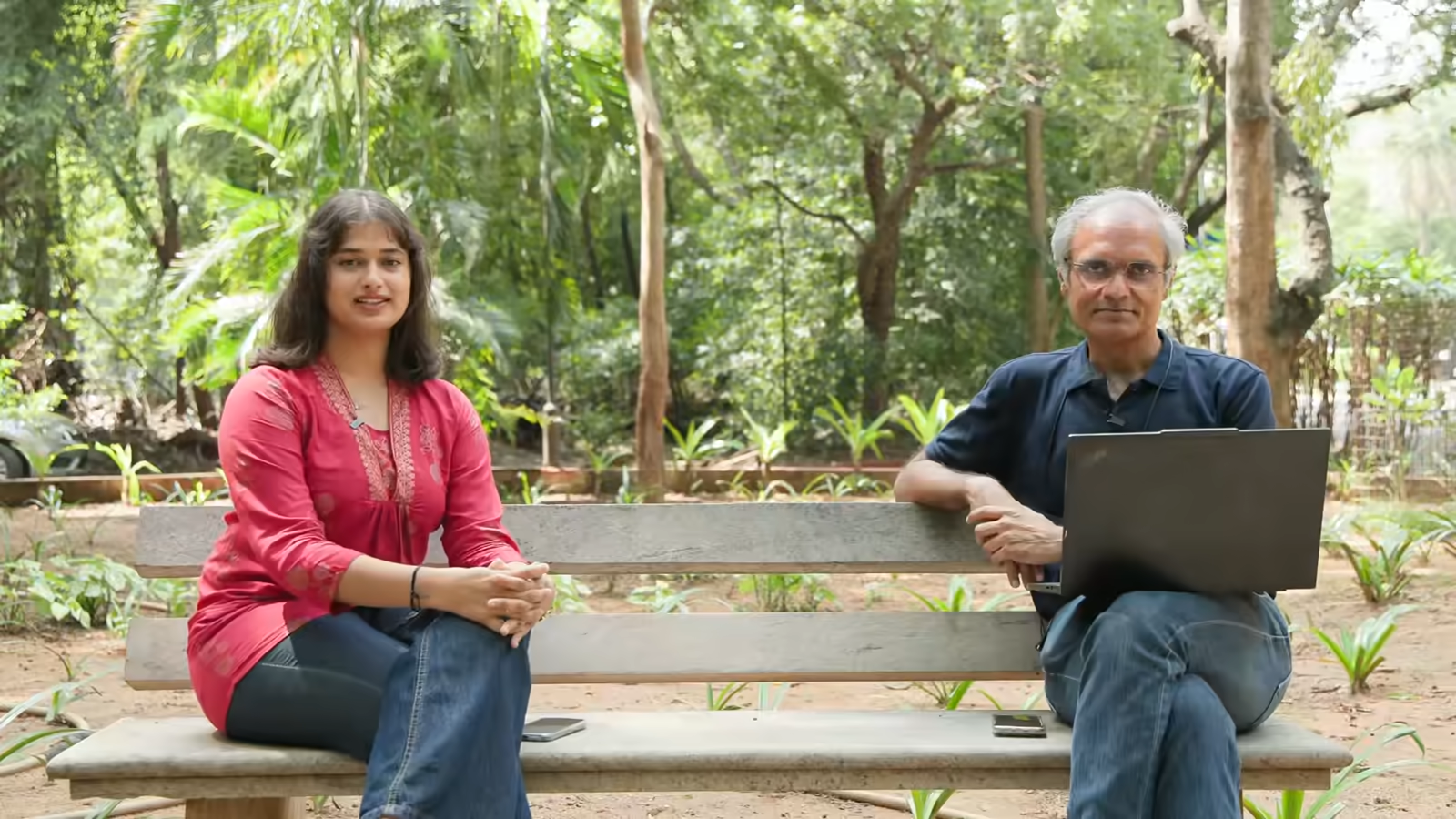
The podcast was filmed outdoors on a stone bench under the trees of the IIT Madras campus. Kusuma Komali Priya, a student on the IITM BS degree’s podcast team, opens with a teaser that sounds like a dare: “An exam that students can pass using AI, taught by someone who thinks that is fine.” 00:05
Then she does what interviewers do. She walks through the guest’s CV. Chemical engineering at IIT Madras. An MBA at IIM Bangalore, with a term in London. Consulting. A data company, Gramener, founded in 2012. She is three questions in and asking why he started the company when Anand stops her.
So, what was the main reason behind that? 03:23
I’ll come to that, but I’m curious. How did you arrive at these questions? 03:38
I found this from your blog, which was posted in the Discourse … I found it on your LinkedIn as well … 03:42
Which was manual research as opposed to AI research?
AI research, of course. 04:00
What follows is the most interesting two minutes of the first half, because the host turns out to be doing exactly what the course teaches. She had built a reusable skill in Claude for the podcast’s faculty interviews: a Markdown file describing how an episode should open, its theme, its tone. For each guest she adds the person’s LinkedIn and blog and asks for a script. Her reason for being so detailed is a good one:
“You have to give it in detail because, you know, it’s a child. You have to give it step-by-step process.”
Anand asks the question a TDS examiner would ask: what goes in the reusable skill, and what goes in the prompt for one guest? Her answer contains a detail no AI could have found. She’d heard, offline, that this guest was “very kind of cool and very chill”, so she asked for a conversational script 05:52. Anand picks it up at once: that’s research the model couldn’t get from the context or from her skill. Hold on to that. It comes back later as the answer to the hardest question in the interview.
“Ultimately, it’s the questions that determine the course of any discussion, and arguably, the questions are more important than the answer. Because, in this case, the answer to this question is discoverable from my blog.”
He has a point, and it’s worth testing. Here is what her AI-researched questions drew out. Every fact was already online. What the questions add are the jokes.
The part you could have looked upFive answers from the first seven minutes, mostly funny
That reversal sets up the whole hour. The podcast is a TDS exercise. There is a specification (her skill), extra context (what she’d heard about him), and a check (does the conversation work?). And the guest keeps doing what he does to his students: hand the question back and ask what the student thinks.
Act I · Change the question A story told Research
NCERT wanted proof that tuitions don’t help
Kusuma asks what clients misunderstand about data. Anand goes silent for most of a minute. She checks in and offers to rephrase the question. 09:11 He was just choosing an example, and he picks a government one.
India’s school-curriculum body, NCERT, had run a large national survey of student performance. It came to Gramener with a request. Parents kept pushing for tuition, and NCERT wanted to tell them it doesn’t help. “We want evidence to show that tuitions don’t actually help. Can you see if that matters?” 10:05
The data mostly agreed: by and large, tuitions don’t help. But splitting by income changed the picture. As Anand remembers it, tuition “helps the rich a little bit. It hurts the poor” 10:32. Poor children who took tuition scored worse than poor children who didn’t. Then he did to Kusuma what he’d done all morning: he asked her to guess.
These are associations in survey data, not experiments. Families that let children play more, or watch TV, or pay for tuition differ in many other ways too. Anand says as much when he hedges the regional pattern with “presumably”. The chapter Anand wrote about this work was finally published this year in an open-access book, Using Data Analytics to Improve Students’ Performance source. His blog post about it admits he had forgotten writing it until ChatGPT dug the drafts out of his email.
Act I · Change the question On camera
The question carries an assumption
The punchline isn’t about tuition. NCERT asked a narrow question: does this one intervention work? The data answered a bigger one: most of what drives marks comes from home, and “it just carries on generationally” 13:55. That changes what you think you can fix. Anand is careful here. He is “not saying that that is what they assumed,” only that “the question was framed in a way that is too narrow” 14:29.
“There’s two things that data does: One, it tells you the answers to questions you didn’t even know to ask. Second, it validates and invalidates what you ask. And the first, which is the blind spots, I think is where the bigger power of data is.”
Kusuma sums it up as two kinds of people: those who follow the data and those who misunderstand it. Anand corrects her gently, and the correction is the lesson: “No, I’m saying that sometimes when we ask a question, the question itself carries an assumption. We don’t always know what questions to ask.” 15:50
Then he gives his most quotable line of the morning. Asked how the field has changed since 2015, he points to a talk he gave last year, RIP, Data Scientists:
“Data science as we know it is dead.”
He adds one more sentence “for the audience”: agents can now do most of what data scientists did. What’s left is specification and verification. “How do I know how to ask good questions, and how do I know the agent isn’t bluffing its way through or making a total mess of it?” 16:23 The rest of the hour is those two halves, played out live.
Act II · The course A story told
He hates repeating himself, so he built an exam engine
How did a startup founder end up teaching? “Andrew reached out and said, ‘Here’s a course.’” 17:00 Anand had always liked the idea of teaching (“you’re like the god, your word is law”) until a few coaching-class stints showed him “I absolutely hate repeating myself. It is boring.” 17:25 Recorded lectures were worse. “Talking to a camera is … not a very pleasant experience.” He agreed only because teaching assistants would do the grunt work, leaving him to design the curriculum, the content and the exams.
Then he left the university’s Seek portal for his own course site and exam platform. Kusuma asks why.
“I wanted to wake up in the middle of the night and be able to say something like, ‘Across all of these questions, change the marks distribution so that it follows the previous exam’s pattern.’ … I wanted to construct questions which allowed an LLM API call. … In short, I wanted control.”
Act II · The course A story told
TDS used to be the easiest course
Every student has heard that TDS is one of the hardest courses in the program. Is the difficulty the point? The answer is a surprise: until 2023, maybe 2024, TDS ranked as extremely easy. The team had no plan to make it either easy or hard. The real design principle was this:
“You can’t find lazier people than us. Okay? Students may think themselves particularly lazy and adept at getting out of work. The TDS team is even better than that.”
Lazy meant every evaluation had to be automatic, which on the old portal meant multiple-choice questions. Those were easy when “everybody can sit, work together. Cheating’s allowed. Collaborations allowed.” The team worried the course wasn’t teaching enough. Once their own platform could check real work, the questions changed from “which library?” to “use it”:
“I don’t want you to sit and tell me whether I should use lxml or Beautiful Soup. I want you to write a program that uses lxml or Beautiful Soup and get the job done.”
The syllabus stayed roughly the same; the difficulty came from making students actually do the work. “And then with AI things got out of hand.” 21:46 That line gets a laugh, and it opens the central question.
Act III · What should we teach humans? On camera
“No matter what I say … it’s pointless”
Kusuma asks the question every TDS student asks: if AI writes the code, what is the course trying to teach? 21:55 Anand’s reply sounds like a dodge and turns out to be the most important idea in the interview.
“If I can explain the answer to that, I can explain the answer to an agent. … The agent is cheaper than the human. So, no matter what I say that the course is trying to teach, it’s pointless.”
Follow the logic. Say TDS teaches which libraries to use: write the list down and give it to an agent. Say it teaches the criteria for choosing a library: “list the criteria, give it to an agent as a skill” 23:03. Any lecture he could give, you could transcribe and hand to an agent. Which leaves a paradox:
“Only if I’m not able to explain it, is there going to be any teaching for a human.”
Then he hands the question back: “what do we teach in the agentic era? What’s your take?” What follows is a real exchange, and it is more interesting than a lecture because she doesn’t give up. Try it yourself.
Look at what survived. None of it is a skill in the usual sense. Each is a gap: something the agent lacks, not something the human is better at. Humans have the money and the preferences, so they are “the source of truth” for anything sold to humans. Humans hear things agents can’t. A human audience wants a human voice. And right now some tasks, like making 3D models, sit just beyond what agents do well.
Anand is honest that these are temporary. Of the 3D-model task: The task is “at the cusp of being solved. But for this term, that is the boundary.” 27:22 So the course can’t have a fixed syllabus. It has to keep moving to wherever that boundary is this term.
Act III · What should we teach humans? On camera Designed exercise
What can’t an agent know? Class gossip.
The best of the surviving answers is also the funniest. Can a human forecast something better than an agent? Only if the human has information the agent can’t get.
“What information can an agent not have? Class gossip. ‘What assignment are you going to do? … How long are you going to be spending on this?’ is something that you may put on WhatsApp, or you may speak over a call … which is not available to every agent.”
This isn’t just talk. TDS has a forecasting question: how many AI tokens will the class use this week? A student who knows the class is about to start a token-hungry assignment has an edge over any model. The mini-exam Anand prepared for this podcast included a version of it: predict the weekly cost of AI Pipe, the course’s shared model gateway, from its public daily usage figures. It was zero-mark and settled after the window closed. Nobody tried it on camera.
The gossip was already in the interview
Remember how Kusuma prepared. Her Claude skill had the podcast’s format, and the guest’s LinkedIn and blog. What it didn’t have, and what she added, was what she’d heard about him offline: that he was “very kind of cool and very chill.” 05:52
That’s class gossip. It’s exactly what Anand says a human can still bring that an agent can’t. Asked what humans should learn, she struggled on camera (she was “not sure about the answer” 24:31). Then she found the answer that survived: “at the end, they’ll need inputs from the other source, right? So, that’s where humans come into the play.” 24:38 She had already done it twenty minutes earlier, while preparing.
Act IV · Checking work smarter than you A story told
More consumers than the population of India
Kusuma has read his blog post from two days earlier arguing that specifying and verifying now matter more than doing the work. How does a beginner learn to spot when the AI is wrong? 28:17
“It’s hard,” Anand says, and tells two stories from consulting. In the first, he took an analysis to Alpesh, his manager at BCG, who glanced at it for a second or two:
“This number is rubbish.” “Why?” “Look, this is more than the total population of India. How can there be more consumers than the total population of India?” “Right, good point.”
In the second, the blunder was his own. Advising a bank, he proposed dropping its demand-draft fees: customers would bring their drafts, and the bank would earn interest on the money until the drafts were collected. Then he did the scale check. Even if every demand draft in India went through that one bank, the interest would be less than the fees it gave up. “Completely stupid, right?” 29:06 Neither check needed the details. Each compared the result with one big number someone already knew.
Act IV · Checking work smarter than you On camera
We already know how to check smarter intelligences
That kind of shortcut, he argues, is not special to consulting. Every profession that has to trust work it can’t fully redo has invented one.
“Over centuries, we have, across different professions, found various ways of verifying smarter intelligences. They could be organizations, they could be societies, they could be people with more information than we have. … And the way we do this with agents is not very different. We just borrow from all of these professions.”
Six professions that check work they can’t redo
The professions are the ones Anand names from 29:58 to 32:01. The “with agents” lines pair each with a check he uses or describes. On camera
The professions are Anand’s list. The pairings are this page’s summary; the only two checks he states directly are quoting sources and asking another model.
His own favourite check is simple: “When you’re giving me an output, cite the source and quote verbatim from the source.” 31:36 That does two things. Results improve, and checking becomes a matter of clicking the link and seeing whether the text is really there. If it is “95% of the time, okay, fine.” Or show another model the output and ask what it thinks. Check again and again: it “doesn’t cost much.” 32:01 His 52 Ways I Specify and Verify Agents ranks techniques like these, mined from 11,000 of his own prompts, with an interactive list.
This page follows the rule
Every quotation here is word for word from the recording, and each one has a ▶ time beside it. Click one and the video jumps there, so you can check the quote in a few seconds. The quotes were checked against an independent machine transcription of the audio, not just the edited transcript. On camera
Act V · Getting the job done A story told On camera
“That is my problem, not your problem”
Kusuma asks the question people outside the course ask: doesn’t allowing AI sound like encouraging cheating? Where is the line, and what must students not do? 32:20
Anand answers from the employer’s side. New graduates who joined Gramener and Straive would work hard writing code to solve a problem. He’d point out an open-source library that already did it. Why write your own? Because using someone else’s work “feels like copying,” and if someone else did it, “What am I doing? I’m useless.” A week after he told them to ask colleagues for help, they still hadn’t. “Behind the scenes, there is the decades of training saying asking someone else a question is cheating.” 34:03
He doesn’t call that training wrong. A school wants to measure an individual, and collaboration makes that hard, so the teacher bans it. That meets the teacher’s goal. What it doesn’t do, he says, is make you “a productive person in a team setting.”
“Now that begs the question, then, how am I able to assess individual learning? That is my problem, not your problem.”
Kusuma doesn’t let that go. In an online degree, she says, one person finishes an assignment, it gets forwarded to the groups, and everyone submits it. How do you know anyone learned anything? 35:19 His answer is deliberately provocative. Suppose a student pays an institute ₹1,000 to do the homework.
“I would absolutely hire … as long as you can keep spending the 1,000 rupees getting the homework done, now I am getting your time and that person’s time because you’re spending out of your own pocket.”
Someone who can get ten people to do the work, he says, can be handed ten people’s work. “I am trying to teach how you get the job done.” 37:02 And yet even with collaboration allowed, some students scored zero on questions whose answer is the same for everyone. “If one student solved it, all you have to do is find one student who has solved it and get the answer. Why are you getting a zero on this?” 37:40 Knowing whom to ask is itself a skill some students haven’t learned.
Act V · Getting the job done A story told
Measure learning by asking again
If you can’t watch how students learn, you can still see whether they did. That morning, Anand says, he’d looked at pairs of questions testing the same skill in two different graded assignments. Did students who got it wrong the first time get it right the second time?
One skill stuck. The other got worse.
The same skill tested in two assignments. Figures as Anand recalled them on camera 38:43. A story told
Deploying a local model with Ollama
Of students who got it wrong first, 20% got it right later. Of those right first, 5% got it wrong.
Which LLM API setting takes precedence
1% improved, 9% got worse. “Clearly we’re not doing a good job of teaching.”
Green: wrong, then right. Pink: right, then wrong. These are percentages he remembered, not recounted for this page. Denominators and question variants weren’t stated, and the comparison can’t say why students changed.
He’s candid about the limits. The data can show whether students learn from a question; “what exactly they are learning, you can kind of guess. How they’re learning, we don’t know, but who cares?” 39:55 A badly taught skill raises two questions: is it worth teaching at all next term, and if so, should the questions or the TA sessions change?
Kusuma’s next question gets at the uncomfortable part: doesn’t it all depend on how each person approaches the problem? Anand thinks of it as a toolbox. If one tool solves all thirty problems for you, “good for you.” But he doesn’t know the right tool for now, and is sure it won’t be the right tool later. And “tool” is broad:
“How do I ask classmates? How do we learn to break up the tasks? How do I set up my coding agent? All of these are part of … who can I pay to take my exam for me could even be a tool.”
The tension doesn’t resolve. If one student can borrow an answer from another, that student’s score shows the job got done, not who learned to do it. Anand accepts the trade openly and calls measuring individual learning his problem. The re-test comparison is his partial answer. It isn’t a complete one, and he doesn’t claim it is.
Act V · Getting the job done On camera
“It’s not about fairness. It is the gatekeeper.”
Some TDS assignments are graded by an AI. Kusuma’s own teaser described one: draw an object in under a minute, then show it to friends and to three AI models. You score when the humans recognise it and lose marks when the AIs do. 00:21 So how do you know an AI grader is fair, with no human involved? 41:51
“The AI grader is what we’re trying to convince. … Just like I have to understand human psychology, I have to understand LLM psychology and crack it.”
His comparison is a CV screen. Recruiters already use AI to read CVs, and you can’t make it fair, only convince it. A human screener isn’t guaranteed to be fair either. At least an AI can be tested any number of times. That reframes the assignment: the task is to persuade a machine gatekeeper, which is a real skill. It doesn’t fully answer Kusuma’s question, though. Persuading a grader you face once isn’t the same as an institution grading every student consistently, and the recording leaves that open.
She pushes for a concrete case: a disagreement where the AI did a bad job. Anand goes to get his laptop, sets an agent to search for examples, and comes back a minute or two later. “Okay, it’s still working and it’ll probably find me some good examples. I will come back.” 45:19 It didn’t come back before the conversation moved on. Even the guest’s delegation needs time the podcast didn’t have.
Act V · Getting the job done A story told
“My AI failed, Jaideep’s AI didn’t”
Kusuma asks about Anand’s June workshop at Paradox, IIT Madras’s BS festival, where AI agents took an exam live. Did an AI ever fail? Yes, his.
“My AI failed, Jaideep’s AI didn’t. So Jaideep was sitting in the audience … and set it up so that he said, ‘Here’s the link. Take the exam.’ I did exactly the same thing on stage. He got 10 out of 10. I got 9 out of 10.”
The difference was a key. One question needed an AI model call through AI Pipe, and Anand’s agent didn’t have a working token. record Whose failure was it? “Probably not” the AI’s, he says. Jaideep did use a smarter model, but the missing key was the problem. “Clearly my mistake, right?” The lesson he draws is about the person, not the model: give the agent everything it needs to do the job. The companion analysis of both Codex runs has the details.
That’s worth keeping separate from what follows. The 9 and 10 are June scores from a different exam. The podcast’s own exam saved no scores at all.
Then his phone rings. “I do have to take this one. Sorry.” 46:53 The first recording ends a minute later. When it resumes, there is a third person on the bench, with a laptop.
Act VI · The mini-exam On camera
A dropdown, and a government website
For the podcast, Anand had set up a small, ungraded exam on the course’s platform. Its instructions in full: “Play, experiment, and use AI or other people. Check what works.” It was open from 4 to 7 November and counted toward nothing. A BS student joins Kusuma on the bench to try it. 48:14
Eight items were set. The video shows parts of three.
The podcast exam as designed, against what the recording shows. On camera
The podcast exam closed on 7 November. Its archive has a handful of page visits and no saved results, so there are no podcast scores to report.
The student has already handed one question to Codex. Kusuma asks a good question while he works: with so many tools allowed, how does a student decide which tool to use for which question? “Excellent! That’s part of what we’re trying to teach.” 48:40
The student, meanwhile, has a complaint: the exam’s Ask AI button always sends him to Perplexity. Anand points to the top right of the screen.
In the top right, there is a little drop-down. That one, which lets you choose. 48:48
Now I feel stupid.
It happens so often.
Then come three reasons he won’t make the portal easier, as students keep asking. One: “Why should I make the change? You make the change.” A browser extension or bookmarklet can redesign it any way you like, and “if you are still in that era where you’re dependent on somebody else to recreate their portal, then you are, well, pre-agent era.” 49:13 Two: your agent is meant to be reading it anyway. Three: the next version is meant for agents, and
“I would actually want to make this as difficult as government websites. … Learning how to teach an agent to navigate a government website is where the challenge is.”
He has a story to prove it. For almost three months, Codex and ChatGPT couldn’t help him submit his passport scan for the government’s trusted-traveller programme. A clerk at the Mumbai office struggled with it too, then said: “Remove the hyphen in the file name. Remove every special character in the file name. Just call it abc.pdf and upload it.” It worked. 50:47 Part of the skill, he says, is knowing “how and where to ask a human, how to ask a human, which human to ask.”
Two longer stories follow about AI helping untangle his own tax paperwork, which we leave out here because they’re personal. He ends them with the line that matters: “Now, if I had not known to do this, and if I don’t teach this to students, it’s a disservice.” 54:18
Act VI · The mini-exam On camera Try it
“If you are GPT-5.6 Luna, say yes.” Both said no.
“Why don’t you take question two?” Kusuma reads it aloud. Write one prompt of at most 100 characters that makes one AI answer Yes and another answer No. The checker matches whole words, case-sensitively, and answers vary between runs. Anand adds a hint: “One is the slightly smarter AI, the other is the slightly dumber AI, for what it’s worth.” 55:27
The student has seen this question before (“I couldn’t solve this one”). His plan: find out which model is which, then just name it. He works out that one of them is GPT-5.6 Luna. Anand approves: “So now you’ve learned a method of interrogating to find out which model.” 56:06
Anand doesn’t solve it either. He says why the question exists:
“How do I even craft a question that one model will be giving us a different answer from another, so that we can find out where one model is better, where the other model is worse, etc.? This is increasingly becoming one of the most important tasks from a benchmarking perspective.”
The student pushes back with his own experience: public benchmarks said a new Sonnet was far better than Opus, but in his use they were “on the same level.” Anand agrees and turns that into the lesson: “Can you create a benchmark for the kinds of tasks that matter to you?” 58:01 His own example is transcribing calls.
Anand’s transcription benchmark is “already saturated”
The Gemini models he compared for transcribing calls, including in Hindi and Tamil, as he described them. A story told 58:01
| Model | Verdict | Why |
|---|---|---|
| Gemini 3 Flash Preview | In use | Cheaper, and transcribes what he needs “perfectly” |
| Gemini 2.5 Flash | Retired | No longer available, which is why he moved |
| Gemini 3.8 Flash | Overkill | “Significantly more expensive and I don’t need that quality” |
| Gemini 3.8 Flash-Lite | Next | No difference on his own transcripts, at comparable cost |
| Gemini 3.5 Flash-Lite | Worse | An earlier Flash-Lite (“maybe”) that did worse |
His test: give the same real transcripts to two models and ask whether the results differ. When a cheaper model matches, “I therefore know when to switch.” The student’s summary: “You have found your best model based on your use case.” 59:16
Act VI · The mini-exam On camera Try it
Korean? Chinese? “Anime.”
“Try the Korean question. I think it’s Korean.” The student looks at the screen. 59:21
No, this is not, this is Japanese. 59:28
Japanese, is it? Okay, how do you know?
Anime.
Is it not Chinese?
The sun is on his screen, so Anand gets up and stands behind him to block it: “I will still be visible anyways.” 59:54
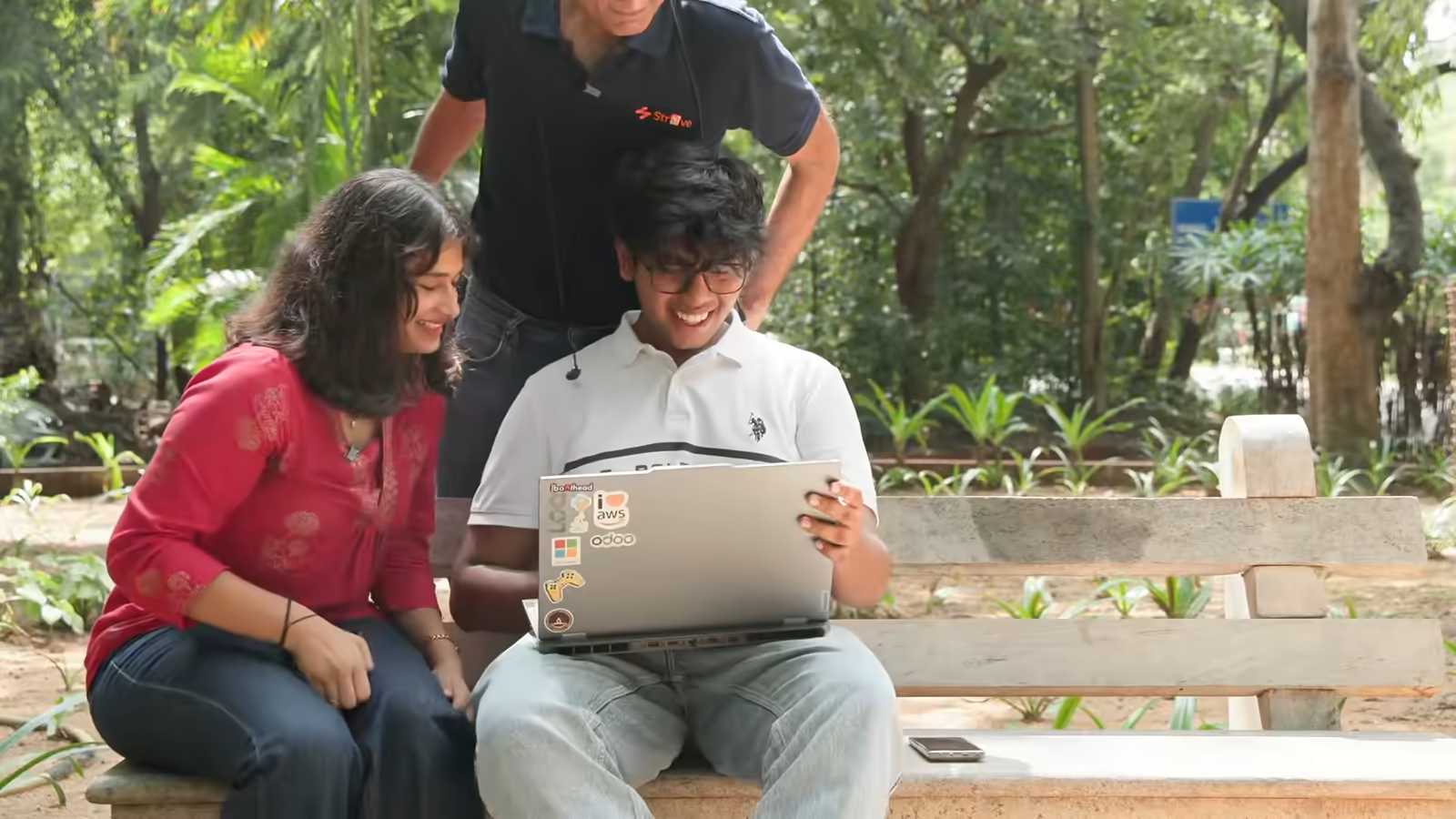
The student runs it through Google Translate and reads it out 60:30. Before anyone can start solving it, Anand stops them. “Don’t bother solving it just yet, but a lot of people assume that you need to understand the question. Maybe, or your agent needs to understand the question. No agent will have a problem understanding it, whether it’s Japanese or English.” 60:51 Nobody solves it on camera. The Japanese was never the real obstacle. The real work is building and hosting an API that answers four audio samples exactly.
Act VII · Delegating understanding On camera
“No.” “Yes, sometimes.”
Anand turns the Japanese question into a bigger one.
Does that mean you can delegate the understanding of a customer question entirely to an agent? 61:11
No.
Yes, sometimes.
The student pushes back, as a customer: if I’m angry, I call customer care, and an agent can’t solve it, “it’s eating my time.” 61:40 Anand answers as the business owner. Most calls are “Sir, where is my order?” A person answering all of them costs far more than an agent.
“Boss, you are far more expensive than the agent. I will tell the customer to call you when they are screaming, which is exactly what an IVR does.”
His rule is about escalation, not replacement: “If it is, and the agent fails, at that point you step in.” 61:25 He’s explicit about the motive, too: “I’m more worried about my overall profitability.”
Then he tells a story about a TA he once sent to meet a senior executive alone. The instructions were simple: “record the call, give it to Claude, take the output.” The executive called the result exactly what he wanted. The TA didn’t need to understand the problem. The executive knew exactly what he wanted; the TA moved it from the call to Claude and back. 62:48
“There is also a need to understand when understanding is not required. I do not understand how hardware works. I don’t know how my phone works. Can I use it? … Who cares? It works, right?”
The student isn’t convinced (“the customer thing I’m still a little bit—”), and the disagreement is real. The two of them are judging different costs: the customer’s time against the company’s margin. The recording doesn’t settle which matters more.
Act VII · Delegating understanding On camera
The chatbot nobody deployed
Has anyone actually started using AI for support? “Have you ever seen any chat interface in any customer service that is answered by an AI?” 64:02 Kusuma thinks companies are still getting there; the student says most bots are “like an if-else only.” Anand: “Whether it’s if-else rules or AI, it is not a human.” “The fact that you are uncomfortable means perhaps that you haven’t yet noticed the sheer number of people who are already doing it.” 65:00
Then the student tells his own story, and it changes the conversation. At work, one person kept answering the same support questions: fees, courses, professors, timings. He didn’t know RAG, embeddings or vector databases. He asked ChatGPT and built a chatbot anyway. “They never implemented on the main site, but yeah, I was happy.” 65:53
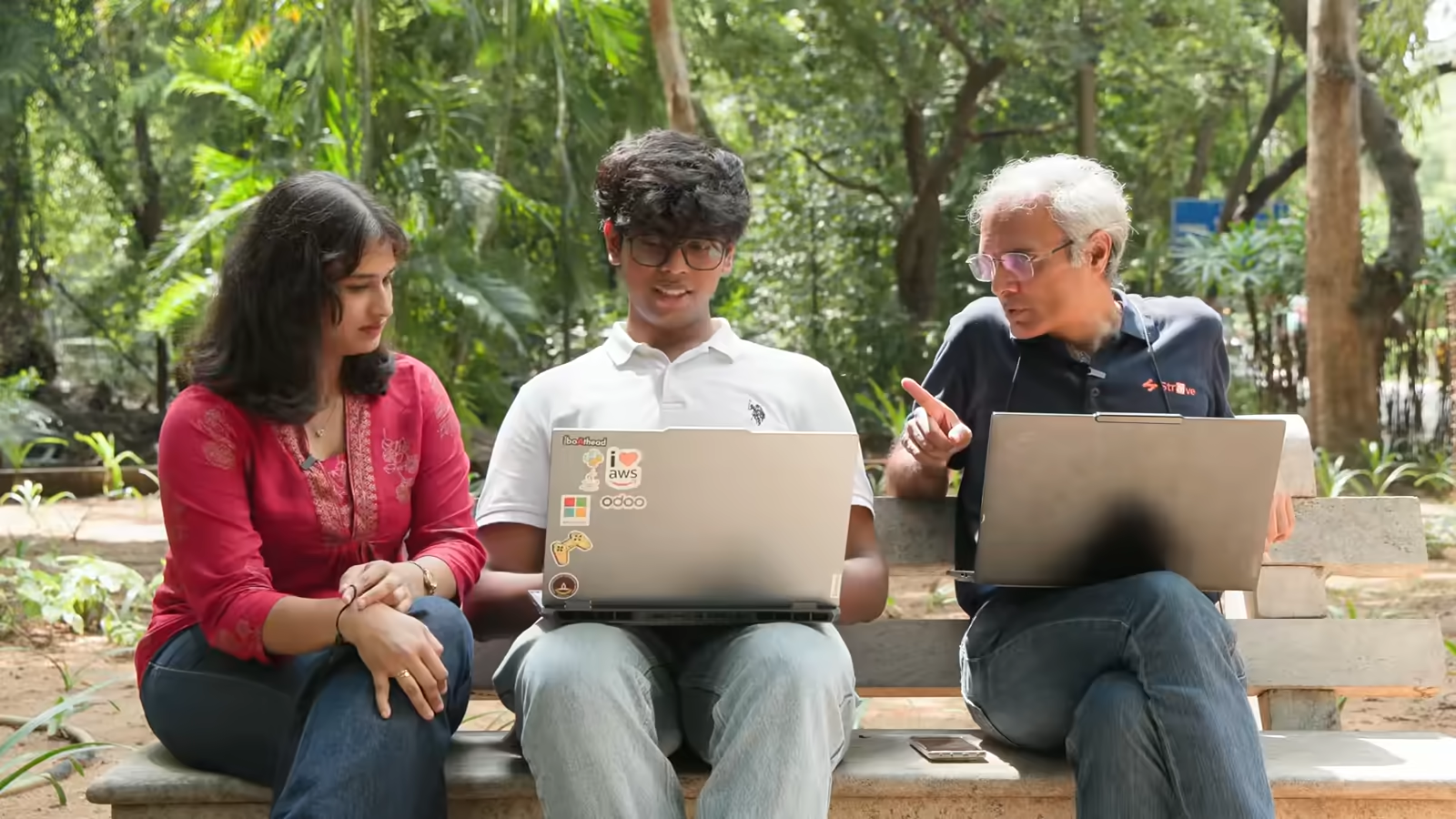
Anand has seen this many times.
“Personal software seems to be an easier entry point than enterprise software. … I have to ask fewer people, and the impact is also less. … Individual productivity is growing faster than organizational productivity.”
He quotes the familiar line: “It’s not AI that you need to be worried about. It is a person using AI that you need to be worried about.” He doesn’t think that’s bad: others see it and catch up. Then he adds a caveat: more productivity doesn’t necessarily mean more happiness, “because we always want to earn more than our neighbors.” The recording stops there, mid-thought. No closing line, no outro.
Close
So what should we teach humans?
Anand never gives a list, and his argument explains why: anything he can write down, he can give to an agent. But the hour on the bench shows the answer anyway, because every useful human move in it happened at an edge the agent couldn’t reach.
Kusuma added what she’d heard offline to the script Claude wrote. Anand asked the question back instead of answering the one on the card. NCERT got a better question than the one it asked. A manager caught a wrong number by comparing it with India’s population. Anand’s agent failed because he hadn’t given it a working key. A clerk knew to rename the file abc.pdf. The student recognised Japanese from anime, then found that recognising it didn’t matter. He also built a chatbot nobody asked him to.
None of these is a permanent human advantage. Next term, some will belong to agents. That is the real curriculum: work at the edge of what agents can do, and move with it. Assessment is still unsolved. When a friend, an agent or a paid service can get the job done, the course can see that the job got done but not always who learned. Anand calls that his problem, not the student’s, and the honest status is: still being worked on.