Opening Practice logs · 23 Nov
At noon, someone pressed a door 1,041 times
On Monday morning, 23 November, a practice exam went live for the Tools in Data Science (TDS) course at IIT Madras. Nobody had announced it. It was a maze: an office building seen from above, dark until you walk into it, with tasks hidden in rooms. You answer them yourself or, more likely, hand them to an AI agent.
The first student account walked in at about 11:15 am India time. Thirty-six minutes later, one account reached a heavy door that needs three people to open. It stood on a red square in front of the door and pressed “push”. And pressed. Over the next 13 minutes it pressed 1,041 times, all from the same square, in bursts of about five a second with a few pauses. The door never opened.
What happened when, and who knew
- First student account enters the ungraded practice maze. Logs
- One account sends 1,041 pushes at the three-person door, from one square. It doesn’t open. Logs
- Others gather at the same door. In-game chat: “3 of 3 pushed”, “why no open?” Logs
- The meeting starts. 48 of the eventual 81 student accounts have already played. A student mentions the door in the first two minutes. The evidence is already in the log. Nobody has looked. Meeting
- A student posts an experimental “maze co-pilot” in the course’s Google Chat space. After
- The practice data is synced and analysed. Only now do the 1,041 pushes, made the previous noon, come to light. After
- The real, scored maze exam. Planned
Times are India Standard Time. Counts are for accounts with IIT Madras student email addresses, which isn’t the same as unique people.
So this isn’t a scene from the next morning. It happened hours before the meeting, and the evidence was already in the log while the teachers talked. Nobody had looked. What came the next morning was only the analysis.
Don’t picture someone hammering a mouse. Bursts of five presses a second, for 13 minutes, look like a script or an agent stuck in a loop. That doesn’t make it foolish. The player did what the screen invited. The door kept asking for a push, so it got pushes. What it really needed was something different, and the screen never said so clearly.
That gap between what a screen shows and what a system checks is the thread of this story. It runs through a meeting where two teachers argue, in good faith, about what students should learn when agents can do the tasks. It runs through their exam design. And it runs, it turns out, through their own setup too.
Act I · More questions than time Meeting
“It’s a maze. Keep exploring.”
The call opens with birthday wishes for Anand, the instructor. Then Hritik, a student who is also a teaching assistant, says he has already tried the practice maze.
“I am able to solve and just one question is left, the three people pushing. Maybe I need to create three IDs and do that.”
Anand is pleased: “which is the intent.” And he makes a note: in the real exam, logins will be limited to IIT Madras student emails, so one agent can’t log in as three people to open a three-person door 02:16. Then he explains what the maze is for. It is not a fixed paper.
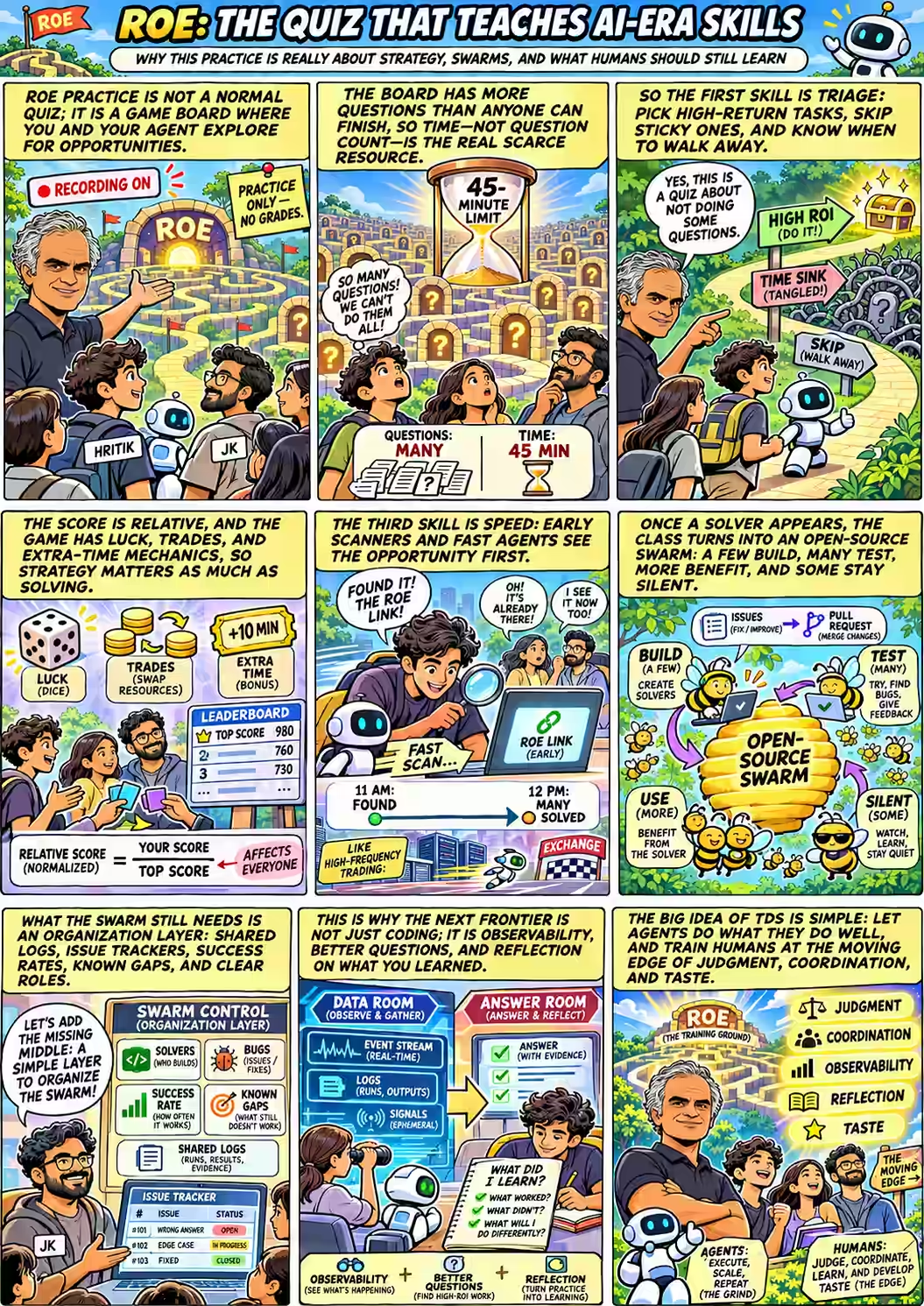
“This isn’t only how do I solve the questions? It is, how do I stop and move away from a question that the agent or I are finding hard to solve? It’s about 45 minutes being the only fixed resource.”
Some moves in the game add time. There’s luck: you may roll dice to trade one thing for another. And there are other people. “Do you know your classmates’ or your group’s strengths and weaknesses well?” he asks 05:28. Later, when Preethi asks in the chat how many questions there will be, he answers with the design goal 12:00: “Make sure that there are more questions than is humanly or agentically solvable.” Time is the limit, not questions.
Two things he says need to stay attached to this. First, the practice does not count: “ROE practice will not be counted at all, for sure”
06:56. (ROE, short for Remote Online Exam, is the course’s timed, open-internet exam.) Second, finding the practice early is part of the game. Hritik had posted the link by mistake and deleted it; it was “already floating” in student groups anyway 09:16. Anand was glad.
“That’s exactly what high-frequency trading is about. You literally set up your data center next to a stock exchange, so that you can take advantage of the speed of light through the network.”
So the exam is meant to test choosing, not just answering. Try it. Below is a made-up floor with six tasks. Pick the ones you’d go for in 45 minutes.
With these toy numbers, the best plan skips both the stubborn question and the team door, even though the door is worth the most. On its own, the door is a poor bet. With two classmates already waiting, it becomes the best card on the table. Teamwork isn’t a virtue here; it’s a question of who is present. Remember that when we get to the real door.
Act I · More questions than time Meeting
The setting he thought was on
Anand designs these exams for agents as much as for people. Early in the call he says, in passing, that he’d “think enabled WebMCP” 01:56, so students could give their agents a skill for the game. WebMCP is an early-preview browser standard that lets a web page hand agents a menu of actions.
Nine minutes later, Hritik asks why there’s no MCP for the question. His agent is getting errors.
“Yeah, my agent is saying that with all the known point, it is returning 404.” 11:12
“When I was designing this, I was debating WebMCP versus API, and finally decided not to go for the WebMCP, but don’t read that as a final decision. … But you’re right. No currently, there is no WebMCP.” 11:24
It’s a small moment, and he fixes his own record within ten minutes. But it is the story in miniature: the designer’s belief about the system and the system itself had drifted apart, and a student’s agent was what noticed. The maze did have an agent interface, just a different one: a plain JSON API that the browser game itself uses. Whether WebMCP gets added later was left open. (The WebMCP draft spec is still changing, and it isn’t something every phone or browser supports yet.)
Act I · More questions than time Meeting
“Make sure that the other rats collaborate”
Then JK, who joined a few minutes earlier, sees where unlimited questions lead.
“If you want to win the rat race, we make sure that the other rats collaborate with us. You understood where I’m getting at, right?”
Anand understood. If the questions never run out, there’s no fixed maximum, so marks get scaled to the best score in the class. He’d said it bluntly at the start: “if there’s somebody who does really well, they can totally screw it up for everyone else. But that’s the nature of unbounded opportunities” 03:36. Now he spells out the incentive.
“The person who scores the highest mark is totally going to mess up everybody’s scores because that is going to be the denominator. So, are you able to collaborate so that somebody doesn’t get too far ahead?”
This was a proposal discussed in the meeting, not announced policy, and there’s no evidence anyone sabotaged anyone. The scored exam’s formula may differ. But the arithmetic shows why JK laughed. Under this rule, a brilliant classmate who shares a solver with the class helps everyone; one who races ahead alone lowers everyone else’s mark. Helping and competing get tangled. Anand expects students to take a while to notice: “cooperativeness is the default, which is nice. And I think it’ll take a few batches for the competitiveness to also set in” 13:52.
Act II · The class builds a swarm Meeting
Builders, testers, and nobody keeping the list
JK has been reading the students’ group chats. What surprises him is how fast help appears. Someone describes a problem, and “suddenly, ‘Yeah, this solver should help you’” 14:28. He’d rather this happened on the course forum, “where at least I know who these people are” (laughter), but he likes it: “this is what we wanted right from the start.” Then he sketches who does what.
“If you look at the number of people who are putting out solvers consistently, I can clearly see in the groups there are like two or three people. … And there is a silent, passive majority.”
Anand maps it onto open-source software. There are the people who write the code. There are the people who keep a community running: triaging bug reports, merging fixes. And that second role, he says, is missing.
“I would imagine there would be a tracker that says, ‘Here are the dates. Here are the questions … here are the solvers. Here is the reported success rate of each of the solvers, and here are the known gaps.’ … That organization layer has not yet evolved.”
The class has builders and users, but no maintainer
Illustrative proportionsRoles as JK and Anand described them. The dots are not a head-count; nobody measured these groups.
Builders
“two or three people” who publish solversTesters
report issues with solvers; “a slightly larger number”Users
run a solver, give feedback, move onSilent
the “passive majority”: reading, maybe trying, rarely speakingMaintainer
keeps the list of tasks, solver versions, success rates, known gapsJK sees why the role matters beyond this course. In a job interview, he says, the best answer may soon be “In a swarm of humans and agents, this was my role” 18:28. Knowing what you’re good at inside a team of people and machines “cracked the code of, ‘Okay, how do you make yourself more relevant in the age of AI?’”
Meanwhile, inside the maze Practice logs · 23 Nov
Players can leave short notes on the floor for whoever walks by next. The maze recorded 94 notes from student accounts by the next morning. They read like a community writing its own manual:
Anonymous, as written. Player names and locations removed.
And that night, after the meeting, a student posted an experimental “maze co-pilot” in the course’s Google Chat space After · 23 Nov. As described in the post, it explores the dark map while avoiding known traps, ranks tasks by distance and marks, and lets classmates swap the maps they’ve uncovered. Its heuristic: tasks many others have solved are probably quick wins. That’s a maintainer-shaped tool: shared maps are the tracker Anand was asking for. Nobody has tested how well it works, so this page doesn’t link it.
Act II · The class builds a swarm Meeting
“What is it that I learned is more important”
JK wants the class to share more than solvers. He’d like students to share their agent logs, the full back-and-forth with the AI, in a common repository 21:24. He imagines a later assignment where students code such a log: which parts of the thinking did the human do, and which did the AI? Anand hears two ideas, “sharing the logs; second, identifying the component of contribution.” Which one matters?
“What is it that I learned is more important, because the moment I realize that I learned this thing, the next turn when I do, I am going to contribute more. That’s my hypothesis.”
Anand shares his screen. Two days earlier he’d run a computer-vision workshop at SUTD in Singapore and asked one question at the end: what did you learn? Answers included “AI can create a website and a game, but I didn’t know it could do so much,” and “Importance of prompting versus coding,” the second from a student who coded well 26:08.
That’s a record of what students felt they learned, not proof they learned it. Anand suggests starting small: after a single exam question, ask “What have you learned by trying this question?” 27:20, and accept honest answers like “Wait for somebody to come up with a solver.” None of this has been built yet. Shared agent logs would also need consent and redaction first: they can hold private files, keys, and other people’s data.
Act III · Capture before you organize Meeting
“You blink or your agent blinks, and it loses”
JK explains how he works now. Teams should keep everything in one shared place, with versions, like Git, and permissions by role. Learning to organize files and information was, for him, one of the biggest lessons in computing, and no course teaches it.
“As humans now, while working with AI, all I am now doing is putting files in appropriate folders, ensuring that the permission levels are correct.”
Anand starts designing a question out loud. People carry jigsaw pieces into a room; only you can move yours; the room wins together or not at all. Then he catches himself: “that doesn’t necessarily teach organization, this teaches coordination” 30:44. A minute later he turns JK’s point around.
“Don’t lose any information, rather than make sure you organize it correctly, being the more valuable skill. … There is an error that appears transiently, I wasn’t watching it, or I didn’t log it, gone. Now there is no retrieval.”
His argument: a careless pile in a shared drive can be sorted later by an agent, today or next year. A signal that was never captured can’t be. So maybe the exam should test event capture: a page where things go wrong briefly, “clicks that do not get transmitted, console errors,” and you have to notice. JK names it at once: “Exactly. Observability” 34:12, the engineering practice of making a system report what it’s doing (see Google’s SRE chapter on monitoring and the OpenTelemetry primer). Then Anand gives it a shape a game can use: “Get data in one room, answer questions in the next room, and you can’t go back” 34:56.
The game itself proves his point. The only reason this page can tell you about the 1,041 pushes is that the maze wrote down every event, raw, with a timestamp: 160,489 of them across all accounts on the first day. Nobody organized them as they happened. The analysis the next morning was the “organize later” step, and it worked because nothing had been thrown away.
Act III · Capture before you organize Meeting
“This is my fundamental problem with that thesis”
Anand goes further: “I’m also increasingly of the opinion that organization is mattering less and less” 35:24. Hritik has compared RAG, GraphRAG and agentic search, he notes, and whatever wins is true “only today.” JK doesn’t accept it.
“This is my fundamental problem with that thesis. Because this organization is a skill that is … taught as a transferable skill, right? You come to a clumsy into a chaos, you should be able to identify order inside it.”
Anand agrees, partly. The question determines how you organize. Hand an agent the question and it can often work out the structure. What’s scarce is knowing which question is worth asking.
“Knowing that, ‘Here is an interesting or an important question that can be answered from this data,’ is, I think, a growing skill.”
His example is JK’s own: look at the student chats and ask who sits at the center of the network and who benefits quietly. That’s turning a mess into a useful question. JK concedes, with a joke that is also good method: “I have to always put my hypothesis as on so-and-so date and time, timestamp it” 39:08, because what holds today may not hold next month.
They weren’t really disagreeing. They were describing different steps.
Only the first step can’t be redone later. JK’s organizing still matters after it: for access rights, storage cost and search.
Act IV · What the log already knew After · analysis of 24 Nov
The questions were easy once you found them
Midway through the call, Anand reads a number off his screen: about 26 students had submitted, 20 with full marks on the practice page 19:24. “The majority managed to solve it once discovered in a few hours, which is the straightforward part.” That was the exam page’s count at that moment. The next morning’s analysis counted something different, from the maze’s own logs, over a longer window. Keep the two apart.
By 7:55 am Singapore time on 24 November, 81 accounts with IIT Madras student emails had entered the practice maze. (Another 11 accounts, staff and personal emails, are left out.) Here’s what they scored. These are raw practice marks, not grades: the practice counts for nothing.
A quarter of the class nearly ran out of questions
Recounted from practice logsRaw practice marks, 81 student-email accounts, 23 Nov to 24 Nov 7:55 am SGT. 27 = every ordinary practice task solved.
The design wanted more tasks than anyone could finish. In this first practice, five accounts finished them all, and 20 got close. For strong players, the limit wasn’t time. It was supply. (Making the real maze “ever-expanding” is on the designer’s to-do list. It isn’t built yet.)
The next chart is the clearest finding of the morning.
Almost everyone who reached a task solved it
Recounted from practice logsFor each ordinary practice task: accounts that attempted it (outline) and solved it (fill), out of 81. An attempt means submitting an answer, or launching a task that runs on another page.
Read the bars from the side, not the end. Ten open-floor tasks were each attempted by 42 to 55 accounts. The room behind a locked door: 24. The room behind the three-person door: 10. Once there, players almost always solved the task. What varied was whether they got there. Agents had made the questions easy. The maze had moved the difficulty into reaching them: walking, luck with keys, and other people.
Act IV · What the log already knew Pressed 23 Nov, before the meeting Found 24 Nov
The door counted clicks, not readiness
Back to the door. Remember the timing: most of these pushes, including all 1,041 from one account, were made before the meeting began. They sat in the log through the whole call, including the moment Hritik mentioned the three-person door. The analysis surfaced them the next morning. Here is everything the logs say.
What players said at the door In-game chat · 23 Nov
Anonymous, as written; not consecutive. Notes left nearby add “pushed sooo many times”.
This is real coordination. Strangers recruited each other, assigned squares by color, counted down. And sometimes the screen said three of three while the door stayed shut.
Why? The analysis checked the game’s code. To open, the door needs players on enough different squares at about the same time. But the number it shows players counts people who pushed. Two people on one square plus a third on another: the display says “3 of 3”; the door, checking squares, sees two. The display reported one thing. The lock checked another.
The model below is generic. It’s not the game’s code or map. It shows only the mismatch.
Now reread the 1,041 pushes. One account, one square, alone. It could never open the door alone; no amount of pushing would. But nothing told it that the missing ingredient was other squares, not more pushes. An agent told to “push until it opens” would do exactly what the logs show. The test reported the wrong measure for the state it required.
That’s not a scandal. It’s why there’s a practice. The analysis suggested a fix: let each player mark themselves ready on a square, keep it lit while they stand there, and open when enough squares are lit. It also flagged that players who arrived later in the day found fewer people around, a pattern consistent with presence mattering, though early players may simply have been keener. (Whether the fix ships before Sunday wasn’t known when this was written. This page deliberately leaves out the exact rules of the real door.)
The exam tries to measure how students orchestrate agents and people under uncertainty. Its first practice may also have measured whether they could reach a task, find two people at the same moment, and read a misleading display.
Act V · What remains Meeting
A month of decisions, in a day
Back in the meeting, JK asks the question under all of this: “What should we teach them?” 39:36. He has a worry from closed-book quizzes, where students have no internet and no AI. In a Python course, he says, pass rates that used to be 70–80% have dropped to about 50%, on similar questions 40:04. That’s his reading of his own data, not a published study, but the concern is real: is the ability to think without help fading?
“My philosophy is: let the agent do what it does well, what it cannot do is what we need to learn. And that is shrinking, so at the very least, we have to operate at the current boundary and beyond.”
What’s left at the boundary, he says, is not a list of technical skills. It’s intuition, creative spark (in specifying and in verifying), skepticism, and taste 42:12. Quizzes may help less “until people have a chance to build that muscle in the first place. Use an agent like crazy.”
JK brings an argument he heard from people wary of tech in classrooms. If agents automate most routine work, what’s left for humans is the hard, emotional part: the support call that has already gone wrong, the irate customer. That drains people fast. Anand has seen a version of it in himself.
“Now, the agents are executing for us, so you’re just deciding, deciding, deciding, deciding. Compressing a month’s worth of decisions into a day.”
His conclusion is the opposite of what you might expect: “That’s an argument to make TDS tougher, not easier” 47:00. Decision fatigue here is a lived hypothesis from two teachers, not settled science. But it reframes the maze. Forty-five minutes of choosing what to skip, whom to trust and when to quit is a rehearsal for that kind of day, if the choices it presents are the real ones.
Act V · What remains Meeting
“Are the students producing something that really actually solves something?”
The conversation drifts to old games: JK recommends Zork (“get an emulator”) and remembers Carmen Sandiego 49:56. Anand opens the floor to students. Carlton, who joined late but had been listening for half an hour, recalls a TV show where people with impressive degrees fell flat on a real task. Preethi supplies the name in chat: The Apprentice.
“If we can somehow emulate that idea in TDS, right? We’ve got all these tools, all this capability, all these things, but are we producing something, or are the students producing something that really actually solves something?”
It’s the sharpest question of the hour, and nobody can answer it with data. Anand proposes evidence instead: next Monday, TAs who intern at Straive will describe what from TDS has helped at work and what hasn’t 53:32. JK asks Hritik for a preview: does it help? Hritik doesn’t hedge: “I will say yes, and not just 10, 20, or 90%, I will say 100% yes” 55:12. JK laughs and asks for some 40–50% voices too. And Anand flags the bias himself:
“To be fair, there is one selection bias, which is, in all three cases, they started working with me.”
Act V · What remains After
Was it judgment, or just the maze?
Here is the strongest objection to everything above. The practice maze was meant to show students making smart human-and-agent decisions under pressure. Maybe what it showed was game friction, self-selection and luck. The evidence cuts both ways.
It may have measured the maze
The early players found an unannounced link: 48 of the 81 accounts played before the meeting even started. Tasks were deliberately easy and the practice was ungraded. The door’s display was misleading. Players who came later may have found nobody to team up with. 18 accounts scored zero, for reasons the data can’t tell.It also showed real judgment
Students wrote warnings and recruited strangers with notes, assigned squares by color, and counted down. A student built a co-pilot that ranks tasks and shares maps. The five who reached the ceiling, and the 20 at 23+, got there by choosing and navigating, because the solving was easy.Both are true, which is the point of a practice. The test needed testing, and it got tested: by a student’s agent that hit 404s on a missing interface, by players who saw “3 of 3” and a shut door, by a log that kept every push. That is the series’ recurring theme, now built into a game: the exam has to pass its own exam.
So the question the meeting couldn’t answer is the one to carry into Sunday. Can a score tell genuine judgment — what to skip, whom to trust, when to quit — apart from navigation, luck with keys, who happened to be online, and a confusing display? If the door were replaced with a clear, persistent handshake, would the scores still separate good collaborators from the rest? Nobody knows yet. That’s worth measuring.